Another Funeral

Unfortunately, since my own parents’ deaths, I’ve had the misfortune of attending a few funerals usually in support of others. There was a colleague’s father, my uncle whose funeral I had to arrange because there were no other next of kin capable or willing to take up the charge, and then yesterday a good friend’s father was laid to rest. In all three cases I was struck by a feeling, hard to recognise but easy to understand once you do, of selfishness. You see, while the reason that I came to the funeral was to support my friend, to show him that I care, and to silently let him know that I’m there for him should have need of anything, what I am doing there during the service is focussing on myself, mourning my own loss and indulging in my own grief.

I was dealing rather well with it all, but tears started to well up when people started to give a last salute at the end of the service. It reminded me of something Moulsari had done during that same last goodbye that stayed with me. She had knelt at the foot end of of my father coffin, touched it briefly and ran her hand over her head. It’s a sign of respect in India, one that I always liked and one that I think my father deserved more in life than he got so I was glad to see that this woman, who barely knew him and only knew how important he was to me, showed him such respect. Call me silly but that really struck me to the point that remembering it, ever so briefly, yesterday, made me very emotional.

Internet Movie Firearms Database

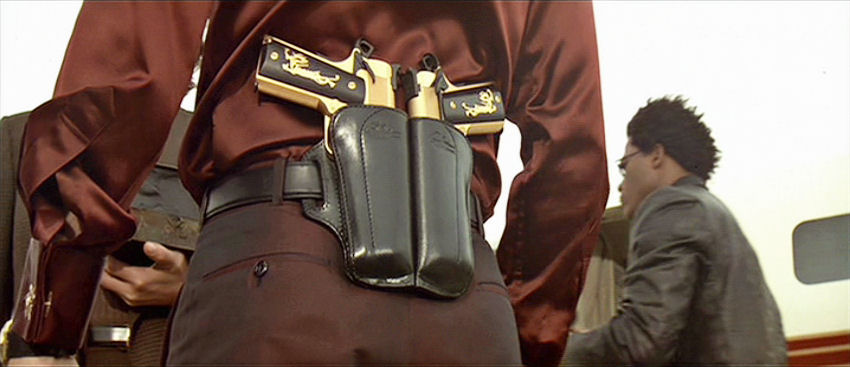
The Internet Movie Firearms Database is, like Al Pacino’s character Lefty says in Donnie Brasko, a “beautiful thing.” It doesn’t particularly make our lives any better, nor doesn’t enrich the Internet in the same way that iMDB has, but you still have to admire the perseverance in setting up, maintaining and contributing to a website like this. Take the 1997 John Woo opus Face/Off, for instance, starring John Travolta and Nicholas Cage. There are more guns in that film than are being smuggled from neglected munition depots in the former Soviet Union, and here’s a guy who’s been cataloging them all! An excerpt:

Castor Troy’s (Nicolas Cage) weapons of choice are two gold titanium nitride plated Springfield Armory M1911-A1 V-10s fitted with custom gold inlaid grips, that he keeps in two small-of-the-back holsters. Among the obvious modifications to the guns include skeletonized hammers, beavertail grip safeties, ambidextrous slide stop safeties, target sites, moderately bevelled magazine wells, and V-10 ported slides/barrels. He uses them both during the first major gunfight of the movie, putting a hole in the windshield of the helicopter Sean Archer (John Travolta) is in and later gunning down several agents in the airport hangar. Later in the movie, when Archer has assumed Troy’s identity and face, he is given these weapons by Dietrich (Nick Cassavettes). He then uses them for the proceeding gunfight as the police raid the building.

Custom Springfield M1911-A1

Rising Sun

Rising Sun - Michael CrichtonA long time ago, I saw Rising Sun, a rather good film with Wesley Snipes, Sean Connery, Cary-Hiroyuki Tagawa and Harvey Keitel. It’s an early 90’s film based on an early 90’s book by Michael Crichton, whom I’ve grown to appreciate more and more over the years. He’s proved to be a suspense fiction writer who bases his work on pretty solid research (or defined assumptions) and manages to tell a technically compelling story while at the same time managing to write  a very compelling story. He can be deep without losing his ability to write stories that read easily. Anyway, he’s my one of my go-to fiction writers when I’m in the mood for something that doesn’t require me to feel bad about my own intellect.

The book deals with the Japana-fear that was sweeping the world late eighties and early nineties, based mostly on the economic powerhouse Japan had become, especially with their trade-surplus at the time. Basically, Japan was the China of the early nineties. I’ve only read the first chapter so far, but it’s very sharply written, painting a clear picture without getting lost in detail. It’s a very sleek and minimalistic book in the way that it doesn’t use more words than necessary. It comes across as very Japanese, where the emptiness in a story is almost as important as the parts that are filled in.

So I liked the film a lot, and had always been curious about the book especially considering my fascination with Cyberpunk, in which corporate controlled dystopia usually has a strong hint of Japanese dominance. (Mostly because at birth of Cyberpunk it looked as if Japan was going to take over the world, economically and then culturally.) I wanted to read some easy fiction, after having read a ton of non-fiction lately. I also wanted an easy read, as the last fiction I read was Nick Harkaway’s Gone-Away World, which is great, but meanders so much that it’s hard to stay focussed on the main storyline which is hardly even there.

My last thought on the book and the film; having seen the film first, I have preconceived notions of the characters and the casting of the characters, and I find myself agreeing with many choices, especially Sean Connery and Harvey Keitel. I’m not sure of Snipes’ casting yet, but it might be a little early to tell.

Thanks Eva for this wonderful birthday gift. :)

A Nagging Injury

Torn ligament.Recently, someone told me that I was being a big puss-cake for complaining about my injuries on Facebook. In order to avoid that happening again, I thought I’d just complain about it here. You see, I have to complain to someone and seeing as how I don’t like to complain to anyone, I’ll just do it here. If you’re here to read what I have to say, you’ve automatically waived whatever rights you thought you had to be protected from my whinging.

I’ve always been prone to certain injuries, mostly to my ankles, which are notoriously volatile. Ever since I was about six or seven years old, since the first time I twisted my ankle, I have had to be careful with my ankles. I’ve torn the ligaments perhaps a dozen times in both feet, and with every time it seems to be getting worse. I’m also getting older, which in turn means that I recuperate less fast and I deal with the injuries for a longer time.

The unflattering photo of my foot here was from two months ago, when, while defending a takedown during a Shooto class, I miss-stepped and tore the ligaments in my right foot. It was very painful and I can still hear the muffled crunch of my ankle giving way when I think about it (and subsequently have to stop myself from getting nauseous.) The pain is one thing, but the aftermath is far, far worse.

I’ve been taking it easy, training a little bit but not doing anything crazy; little wrestling, little judo, mostly ground work and stand-up. And yet, even after having had a month of little training and quite a bit of relaxation, it only takes one afternoon of heavy lifting while I help someone move their belongings to a new apartment and I’m back to square one. It’s not like I can’t jump, or draw a short sprint or, you know, do heavy lifting, but it just hurts.

Escapism, Romance and Cowardice

Escapism
I have often wondered why I enjoy a lot of things that I do. Computer games, roleplaying games, books, films; all of these things offer me endless hours of entertainment and delight. I can’t say that I haven’t noticed the pattern of escapism that runs deeply through a large part of my hobbies and also the immediate lack of usefulness that these hobbies present. I don’t teach myself anything immediately applicable by playing games or watching films, I’m not unlocking some hithereto undiscovered talents or honing my vocational skills. Sure, there are many secondary things you might pick up; roleplaying games are all about creative and social problem solving, computer games sharpen the mind and hand-eye coordination and I’m sure there’s tons of knowledge you pick up through osmosis from films and books. (Who doesn’t know how to reload a 9mm nowadays when Hollywood has been such a source of education.) I’m not saying there aren’t benefits but equally, there are more immediate things I could be spending my time on, like redoing the bathroom, work or more direct education. I don’t. It’s exactly my point not to.

Romance
It’s my romantic urge that drives me to do these things. Not the popular definition of romance, but the literary definition of it; an escape from the confines of the mundane to explore the exotic, the unusual and the fantastic. To harness the power of the imagination to envision things outside of the immediate, the now and the pragmatic. To want something more than what is practical and instead to focus on what is best. I’m not a perfectionist by any stretch of the imagination, and most people would consider me more practical than an idealist, but I do have dreams and often fantasise about what I could be given different circumstances.

As a semi-related aside; I’ve noticed a trend among many of my friends in which people are drawn to apocalyptic films, television, books and other sorts of entertainment. The focus always lies in some earth shattering event that unravels the normal social order and thrusts the survivors in unusual and remarkable situations where survival counts on spectacular and heroic feats. Whether it a global zombie infestation, a mysterious illness that wipes out whole civilisations, or a gigantic undersea earthquake that sends a massive tsunami to wipe out large parts of the coast, throwing the world into anarchy, chaos and disarray, it always leads to the same premise; the mundane will perish, the resourceful and unusual will remain. I think a lot of my friends think they have more to offer than their lives are currently making use of. I think a lot of them, including myself, have been feeding on the American paradigm that we are all beautiful and unique snowflakes, or that we are the ugly duckling; that we will all one day be reborn as a beautiful swan, given the right circumstances. That we are misunderstood, underappreciated and that one day something will happen that will allow ourselves to reach our full potential. I’m just not entirely sure why this particular something should be a complete collapse of modern day society, but it seems to be the key.

I am having a hard time imagining this to be anything but a first world fantasy. I can’t imagine anyone who has to wake up every day to a war-torn country, or who lives under the yoke of a dictatorial oppression to fantasise about his life being overwhelmed by zombies. Perhaps they would dream of a great flood that would wipe away the ruling order that oppresses them. Perhaps it’s not much different than what we dream of after all.

Cowardice
We’d all like to believe we’re special and that we’re currently not because the circumstances aren’t right for us to really shine. I wonder why so many of us think that we’ll do better under the pressure of a zombie horde while we can’t even get our shit together when our lives are relatively meek and normal.

I believe that we think the trappings of a normal life — a nine-to-five, a mortgage, the materialist rat-race, raising a family and paying taxes — is standing in the way of greatness. It’s preventing us from being who we really are. The escapist in us longs for a life without these trivialities, without these diversions, so we can focus on what is best, what is right, instead of what is comfortable and practical.

I think it’s an unfulfilled desire to be free from the mediocre existence most of us live in. We want to be freed from mediocrity and be launched into excellence and exception. We want this vehicle to be bigger than ourselves, because we’re lazy. We want it to be an act of God (or Lucifer) because then it’s out of our hands and we’re not to responsible. All that because it’s easier than changing our lives from what they are today to what we really, truly want them to be. We’re too cowardly to take up the charge to change our lives now instead of sit here and wait for a biblical plague to change it for us. We believe there’s greatness inside of us, but we don’t want to be responsible for unlocking that greatness, for setting it free.

We don’t really want to achieve greatness. We’re comfortably numb in our mediocrity and we’d rather dream and talk about this perceived greatness we think we can achieve under the right circumstances. It makes us feel special without having to be special.

It’s like wearing black clothing because it’s easier than exercising.