Blessings and Burdens

Previously, the heroes split into two groups. Chakuq, Neamhan, Luca, and Esmeralda went to secure Réonan’s support for their plan and thus use the Circle of Magi as a power source in the binding circle. Though the decision clearly pained the grand archmage, they considered the plan bold and likely to succeed if the heroes committed themselves to it. In the meantime, Quentin and Emrys went to find Prior Benedict in the woods outside of Kingsport.

Tenth Day, Second Ride, Autumn Twilight, 1262

(Silvermoon is waning, Bloodmoon is waxing, Darkmoon is waning)

Emrys and Quentin hiked up the road that ran past the woods in which Prior Benedict was camping and it did not take long for them to spot the smoke of a small fire coming from inside the woods. They departed the path and made their way through the thick snow, quickly picking up tracks which lead them to the camp. There, they found Adelard, the prior’s assistant and translator, who welcomed them and offered them broth. Soon, they were joined by the prior and he was pleased to see them both, but the joy he felt at seeing Emrys was profound.

Prior Benedict shared that after his speech at the Cathedral of the Platinum Father he and Adelard went north to Gryphon’s Roost. One reason for his return to the order that he belonged to was to debrief, and update the order on events. Another was to get back in touch with some of the crusaders who had decided to return to the order. There they heard that some crusaders had put down their swords and had surrendered themselves to a life of peace, others had returned to their orders, or their lands, and others still had turned to a life of brigantry.

An important conclusion that Prior Benedict arrived at was that he wanted to remedy the problem he saw with the current ecclesiarchy of the Church of Paladine by offering the believers an alternative that was much more in line with what he was taught. The prior believed that the Verdant Kingdoms was ready for a different, and deeper kind of faith.

When discussing their plan for Epidemius, the prior said he’d be less able to help the heroes power the binding circle. He would require a lot from himself in establishing his new church, and therefore had to decline participating. However, Emrys and Quentin agreed that Prior Benedict would offer Paladine’s blessing to the heroes and their comrades before their confrontation with Epidemius. He would come to them on the morning and bestow Paladine’s blessing in the dawn’s light.

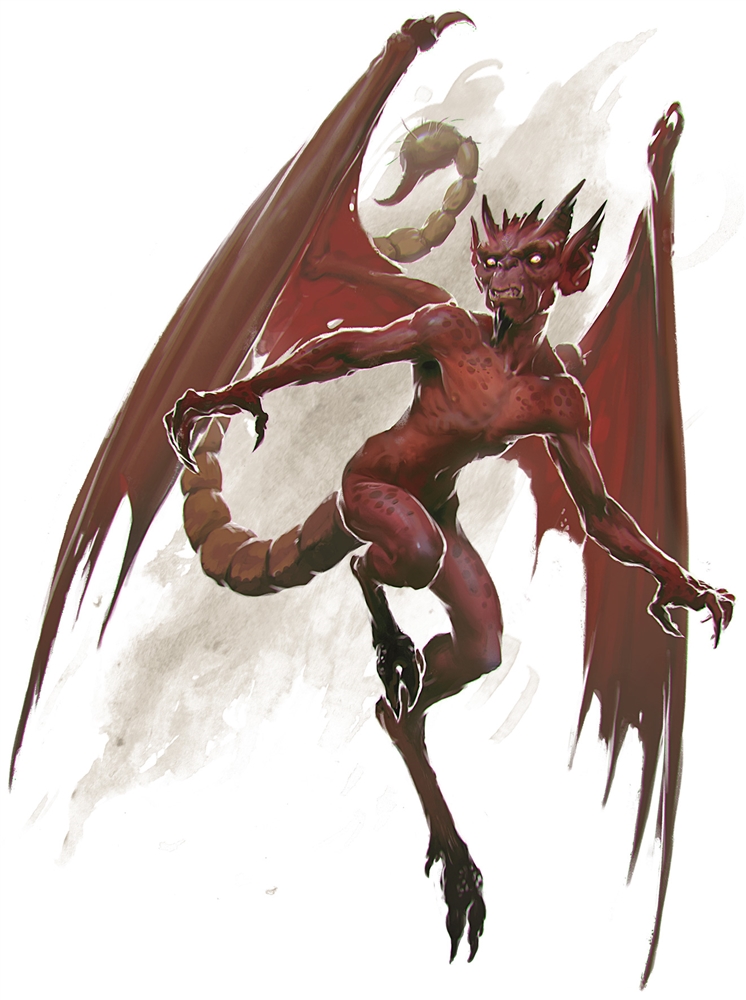
The prior did approve of the chosen strategy, and believed that if enough discord could be built up in Epidemius that he may well lose his divine animus and become mortal. Even if he would not, the prior reasoned, Epidemius must have gambled a lot of his capital on the incursions across the veil, and even if the heroes would banish him back to the Nine Hells, the reception awaiting him there would not be a friendly one.

There were several discussions and observations that Emrys and Quentin made during their time with the prior and his assistant. Quentin was eager to understand what happened to Durand de Palmerin, the squire to Ser Estienne d’Epines whose body he inhabited while in Old Llygad, and learned that he had laid down his sword, returned to Beauclair, to live his last years in peace. Adelard, who had temporarily excused himself from the conversation to run some errands, came back with some provisions, including some Beauclairois wine of great quality, which was very curious.

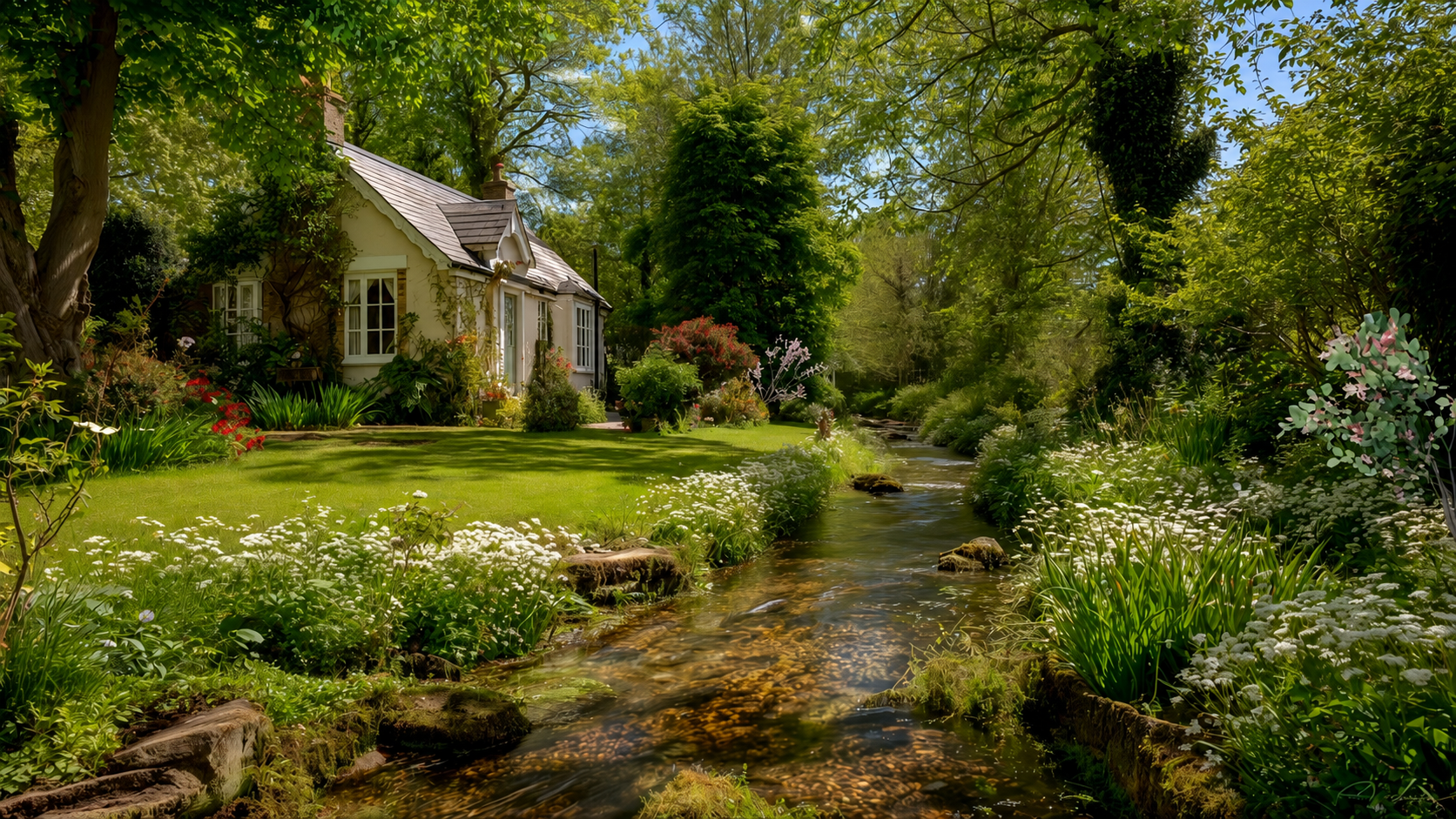
During this time, while Chakuq and Luca enjoyed a cup of Miðgarðurian spirits with Olafur, to stave off the cold and the boredom, Neamhan had convinced Esmeralda d’Ortega, the headmistress of the Circle of Abjuration, after having asked her for a moment of her time. Neamhan had indicated earlier that she wanted to discuss the possibility of having her memories altered, and Esmeralda thought it best to find some privacy. The headmistress lead Neamhan down the long corridor to a particular door behind which lay a beautiful cottage garden along the bank of a small river. The weather outside was warm and pleasant, with a gentle breeze. Flowers, bushes, and trees were in bloom and fragrance filled the air, alongside the buzzing of bees and dragonflies, and the song of birds. They sat at a small table set with warm scones, jars of clotted cream and jam, and a pot of tea.

It quickly became clear to Esmeralda during their conversation that Neamhan was concerned with Virulencia’s interest in her,  and the devil’s suggestion that she was a mother. Neamhan was worried that she was, in fact a mother, and that her memories had been made to forget. Esmeralda reminded Neamhan that Virulencia was a duplicitous creature, and that she should not be so eager to believe what she was trying to make Neamhan believe. Esmeralda scrutinised Neamhan and claimed not to see anything that suggested altered memories, but also admitted that it was not her field of research. Neamhan confided in Esmeralda and said that she had angered the Good Sisters and that they might be behind it. Esmeralda grew worried, and said that they possessed an old and powerful magic that was difficult to unravel. Defiantly, Neamhan said that what she had achieved was worth angering the Good Sisters over, to which Esmeralda retorted by questioning whether it was worth forgetting her children over, which was not something Neamhan knew how to respond to.

Esmeralda and Neamhan ate in silence, and the headmistress decided to approach it from a different angle, and asked Neamhan whether it was possible that she was carrying a child. This was a surprising question, and Neamhan decided to seek advice, first from Lauryn, and perhaps from one of the clerics at the Temple of Light, devoted to Pholtus.

The two women sat together in silence, enjoying the scenery and food, and eventually went back to the entrance hall of the Circle of Magi to rejoin Chakuq and Luca.

Chakuq and Luca suggested visiting the Temple of Light to ask Father Devon if he knew anything about the Monastic Order of Apothecaries, who had been charged to care for the Liber Bubonicus when Epidemius lost it at the Battle of Three Forces. This suited Neamhan well, but she asked if they could return to the Careless Wanderer first. When they arrived, Neamhan immediately asked Lauryn for help, saying that she might be pregnant. Lauryn was very excited and immediately dropped what she was doing to accompany Neamhan to the Temple of Light.

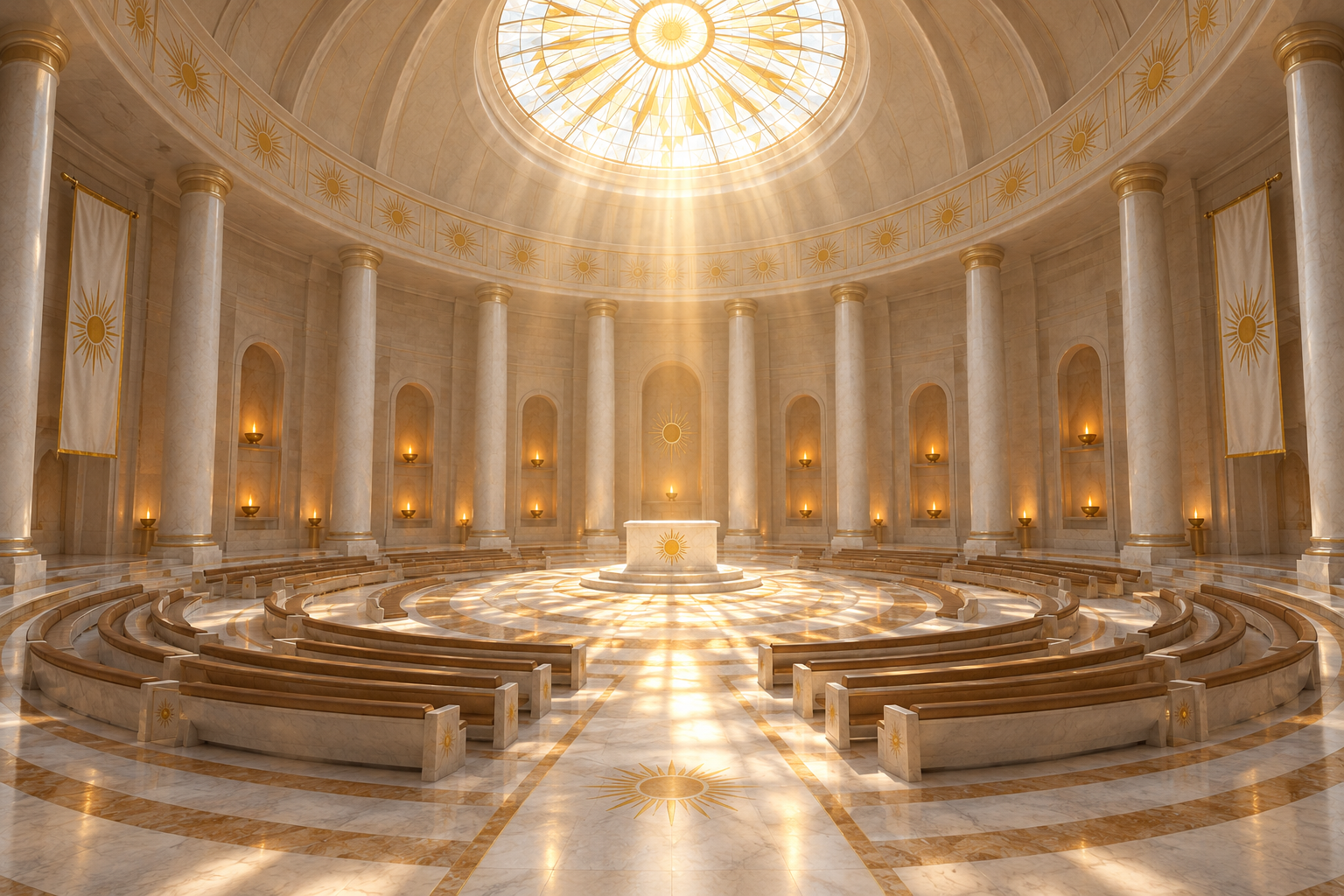
Chakuq, Luca, Neamhan, and Lauryn made their way to Steward’s Square, and saw the large group of people gathering in prayer on the steps of the Cathedral of the Platinum Father. This was a development none of the heroes had the bandwidth to investigate, so they walked past and entered the clinic where they soon found Father Devon.

The kindly cleric could not share any information about the apothecaries, nor the book, and claimed not to be particularly pious or scholarly, simply a dedicated physician. However, if anyone was able to share more information about what the heroes were after, it would be High Priest Selwyn, and Father Devon would see what he could arrange.

Chakuq suggested their next stop should be the Sacred Baths of Sedna in order to speak with Emma. That would give Father Devon enough time to set up audience with the high priest. Neamhan excused herself and stayed behind with Lauryn to get a checkup, but the cleric was unable to tell and so suggested to come back in a few rides. In the meantime, he advised Neamhan to eat more spinach and raisins and to refrain from drinking strong drink.

When the heroes arrived at the sacred baths they were met with Dagmær, who, when she learned that the heroes were there for Emma, lamented that it would be nice for the heroes to visit the baths for its water some time. Luca, ever the diplomat, ignored the comment and asked to see Emma again. When the heroes spoke with Emma and explained their plan, and asked her to get in touch with Bláthnaid, Emma said the spring under the palace was too young and too inexperienced to serve such a grave purpose. In return she offered the power of the river Lyn, which fit the circle well. It did leave the question who the source of power in the palace would be. Perhaps the queen?

The Burden of Kin

Previously, Aurion, Luca’s celestial patron, confirmed that the heroes’ binding circle plan was viable and suggested two approaches: direct combat, or turning Epidemius’ entropic nature against himself. He also revealed that confronting Epidemius with a sigil representing his original purpose might give the heroes a crucial advantage.

The heroes decided the subtler approach was preferable given the risk of collateral damage in Kingsport, and visited Esmeralda at the Circle of Magi to discuss how to proceed. She warned that the copper beneath the city’s ramparts, needed to power the binding circle, was in poor repair and would need fixing before it could be used.

Tenth Day, Second Ride, Autumn Twilight, 1262

(Silvermoon is waning, Bloodmoon is waxing, Darkmoon is waning)

The Vigil of the Undimmed Eye

They were set to watch, as all Grigori are set to watch, and they watched with the full and patient attention of one whose eye is the sun itself, seeing all things, casting shadow from all things, warming and revealing and making plain. He did not intervene. This is the covenant of the Watcher; to observe and to record, to bear witness without hand laid upon the witnessed. For an age they kept this covenant and found it an austere sufficiency, the cold satisfaction of the perfectly fulfilled duty. Then they looked down, as they always looked, and saw the suffering that their light illuminated, saw it clearly, as one whose eye is the sun may see clearly, and understood, in the manner of an angel who has watched too long and too well, that they had recorded enough. That witness without mercy is its own cruelty. That the eye which sees all and does nothing has become, in its perfect faithfulness, a kind of instrument of the dark. They did not abandon their watch. They could not; they were made for it as a river is made for its bed. But they turned their light, thereafter, with intent, warming what was cold, revealing what was hidden, not to expose but to protect. The Host called this transgression, and they accepted the word with serenity of one who has looked upon every argument against their choice and found them, in the light of their own eye, wanting.

Angelarium, on All Angels, Including the Fallen, by Gustav Davidson, Imperial Researcher to the Adelheim Throne, 1018.

Falka’s reading of the passage stunned Esmeralda to silence. Falka also concludes that Zerachiel seemingly went against their own word. Quentin concludes that there was no difference between Epidemius and Réonan; they both watch and record. Chakuq proposes that Zerachiel (or Réonan) might be a source that could power the binding circle and disagreed with Quentin that there was no difference between them and Epidemius; Zerachiel was appalled at the suffering, broke their charge and wanted to limit the suffering. Chakuq believed that there might be an opening to see if Réonan was willing to help more.

Neamhan wondered whether Réonan might be a reminder to Epidemius of what he had become, since he and Zerachiel knew each other. Could this be a reminder of a way forward? Quentin suggested that it may be a reminder of what lay behind, instead. Luca did not think it was a bad idea. Emrys sided with Quentin and Chakuq and recalled to the others what Epidemius and Réonan said to one another on Steward’s Square;

Réonan: “On the day you were born, the very forests on the slopes of Mount Celestia whispered the name… Epidemael.”

Epidemius: “‘Behold Zarachiel, a man clothed in linen, with a belt of pure gold around his waist. His body was like a topaz, his face like lightning, and his eyes like flaming torches, his arms and legs like the gleam of burnished bronze, and his voice like the sound of a multitude.’ You are one to speak brother, what happened to you, you pitiful wretch?”

The heroes decided to speak with Réonan to secure the Circle of Magi as a source power, speak with Prior Benedict to secure him as a source of power, speak with Emma to secure Bláthnaid as a source of power. Father Devon also warranted a visit, to see whether the heroes could learn more about the Monastic Order of Apothecaries, who had the Book of Woe in their charge since Epidemius lost it; hopefully it would help to understand how the book could be made to cause discord within Epidemius.

Chakuq, Neamhan, Luca, and Esmeralda would visit with Réonan, while Quentin and Emrys would visit with the prior. Then afterwards a visit to Father Devon and Emma would be attempted. When Esmeralda asked to join in on the conversation with Réonan she was asked whether she had been aware of the grand archmage’s nature, and Esmeralda said she had a suspicion. She admitted that she had ambitious plans for the Circle and her position within it, and when Chakuq asked whether she could wait until after Epidemius was dealt with in order to shake up the hierarchy at the Circle she responded that she had been patient since she was a little girl, and could maintain that patience for a while longer.

An audience with Réonan was arranged while Quentin and Emrys headed out of the city in search of Prior Benedict. The audience took place in Réonan’s inner sanctum at the top of the tower. Neamhan marvelled at the opulence and grandeur of the space and the incredible view over the city.

The heroes explained their plan to Réonan. The idea was to channel or redirect Epidemius’ power through the book in an attempt to disperse that power throughout Kingsport in an attempt to heal all of the victims of his curse. It would consume Epidemius, but Réonan assured the heroes that it would lead to Epidemius’ destruction, not his redemption. Réonan commended the heroes on a bold plan and confirmed that it certainly could work if the heroes had faith and committed to it.

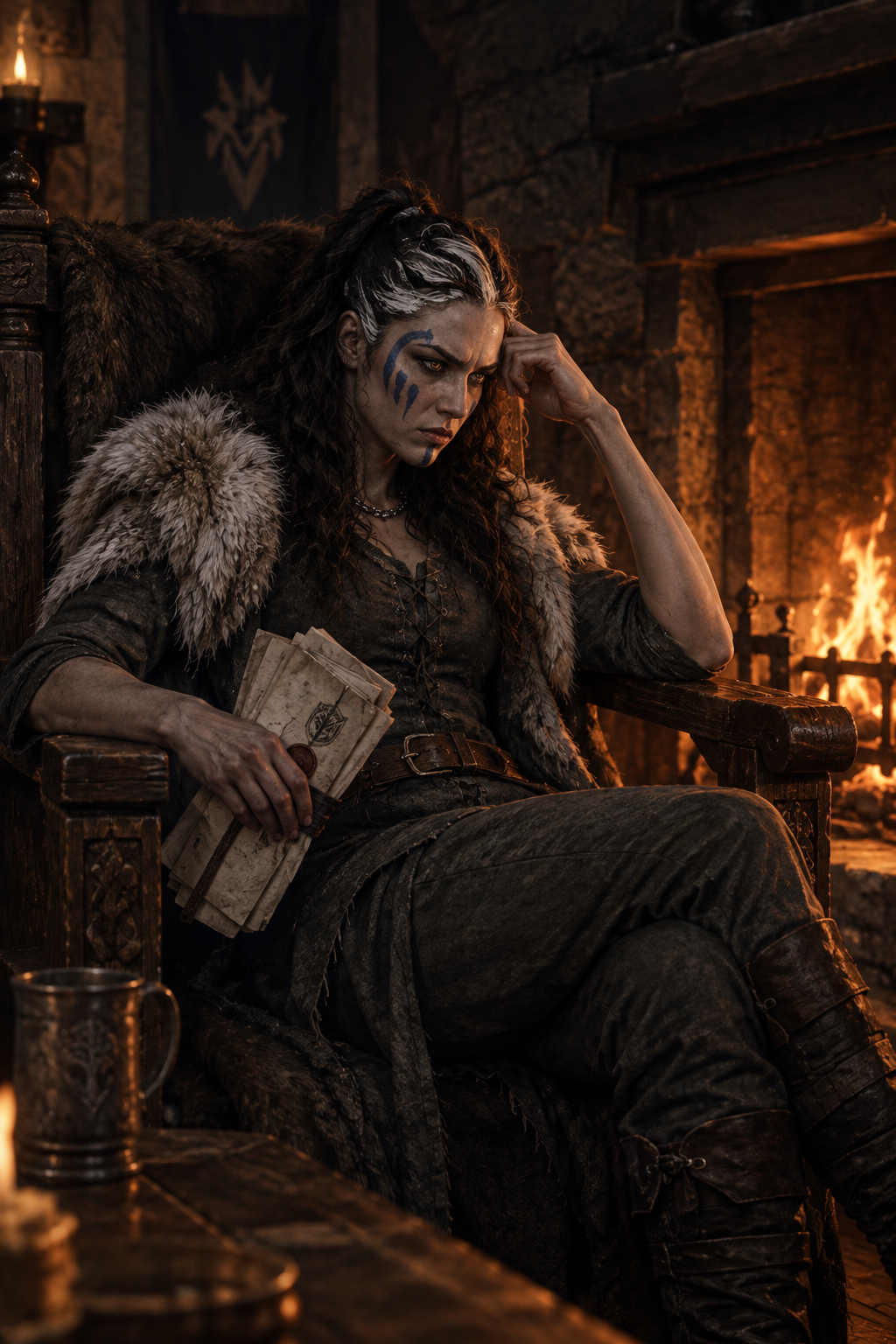
The conversation was ultimately successful, as the grand archmage granted support from the Circle as a source of power to fuel the binding circle. It was a difficult decision for Réonan because their head said to support it, while their heart said not to. When asked why, Réonan said, emotionally; “He is my brother,” as if that explained everything. Réonan also said that their refusal to help with this would mean that Esmeralda, whom they referred to as a duplicitous viperess, would have cause to bury a dagger in their back.

Once the decision was made Réonan asked the heroes to leave them as they felt hurt by having to make such a hard decision.

The Tethered Ones

Previously, the heroes regrouped at the Careless Wanderer after defeating the Cult of the Dark Queen, and sheltering three children caught up in the skirmish. Epidemius made his presence felt by possessing one of the children and delivering a grim warning; the return of his Book of Woe was non-negotiable, grotesquely killing the child to make his point. The following morning, Falka shared her research on Epidemius, revealing that forcing the fallen angel to create or heal could turn his own entropic nature against him. As the group discussed their next steps, Luca made a significant revelation of his own, introducing his patron, the celestial being Aurion, who manifested dramatically before the assembled heroes.

Tenth Day, Second Ride, Autumn Twilight, 1262

(Silvermoon is waning, Bloodmoon is waxing, Darkmoon is waning)

Luca’s patron materialised from the young warlock’s shadow as an tall figure with large wings, looking much like the celestial warriors the heroes had seen in many of the older ruins and Senhadrim vaults. His face was hidden in a deep, slender cowel. He had broad shoulders and an impossible waist, with two sickles hanging on each hip. Luca introduced his patron as Aurion, formerly known as Aurius the Golden One, whom many of the other heroes recognised as the mythical hero fighting alongside the Silver Crusade during the Age of Fear. Luca explained that Aurion used to be a celestial messenger for Paladine, but caught and corrected himself to say that Aurion still was a celestial.

Aurion listened to Luca as he asked his patron for his opinion on the approach that the heroes were taking in utilising a binding circle to trap, anchor, and ultimately defeat Epidemius. Aurion confirmed that it was possible, that “Epidemael”, which was the name Aurion consistently used to refer to Epidemius, would not be easily tricked. The interaction with Aurion felt alien to the heroes, with the celestial often letting silence fill the room to the point of discomfort, standing so still it was as if the heroes were conversing with a statue. At other times, he shifted his attention from one hero to another with such determination that it felt as if the weight of his attention pushed down upon whoever he was addressing with the weight of a mountain.

Many of the heroes sought to distract themselves from that oppressive, hooded gaze by looking elsewhere, and as they did so they started noticing things. Neamhan noticed a stone pot on Emrys’ balcony, mostly covered in a thick layer of snow, which showed a small, purple flower starting to bloom, against all odds. Quentin noticed that among the smouldering ashes of a long extinguished hearth there was a single flame that refused to die down. Chakuq noticed a bird nesting outside the window with small chicks happily finding comfort amongst its feathers, which was unusual for that time of year.

Aurion explained that the heroes broadly had two choices; either to confront Epidemael by binding and defeating him, or by turning his entropic power against him. The first would be the direct approach, which Aurion likened to the application of a blunt instrument and therefore dangerous. The second was much more difficult to achieve, but would leave the heroes largely out of harm’s way. He mentioned that the heroes had proven to be effective, blunt instruments by defeating his brother Xamael. Another thing to consider is the location in which Epidemael would be confronted; Kingsport. Xamael was confronted in the depths of a sunken vault in the middle of a remote marsh, with few innocents around to fall victim to the confrontation.

The celestial patron also suggested that the heroes could get an advantage on Epidemael if they could confront him with his original purpose. Aurion assured the heroes that he feared it more than anything else. The celestial shared a sigil which resembled the primordial word meaning “forward”, and being confronted with it might make him hesitate for long enough to allow the heroes to gain an advantage. Aurion explained that he was unable to interfere and he mentioned that he was “not allowed to be here”, which meant he was only able to influence and advise, as well as use agents like Luca to achieve objectives. When asked which approach Aurion would recommend to the heroes, confrontation through combat, or manipulation by turning Epidemius’ nature against himself, Aurion gave a dissatisfying response that spoke about trade-offs. Using Epidemael’s entropic nature against himself would be harder, but might prevent a lot of collateral damage.

The heroes, Neamhan in particular, asked Aurion several questions; Virulencia was after the book, and Aurion assured Neamhan that she was bound by the same rules that he was; she could only influence, not interfere. That did not align with what Epidemius was able to do; he had manifested himself and had gone well beyond influence. Aurion assured the heroes that this came at a great cost to the fiend. Furthermore, Oishin was a Senhadrim that Aurion had heard of, but never had interaction with.

Before his departure, Aurion said that it was no coincidence that the heroes had achieved all that they had. He believed it was because there was hope left in this cause. He claimed that he did not champion causes because they were hopeless, but because someone had to believe that it could be won.

“Belief has a weight of its own.”
– Aurion

Then Aurion left. It did not feel like an exit. The heroes were not sure when it began, but somewhere between his last words and then, the quality of his attention shifted. It wasn’t shifted away from the heroes or the conversation, but outward, as if he heard something at a great distance which required him to be elsewhere. Between one breath and the next he simply was no longer there. It felt like setting down something the heroes had been carrying for so long that they had forgotten they were carrying it, but then in reverse. Like something had been picked back up. Like they were, again, being held in someone’s attention. He was not there, but he was not gone in the way that things went when they left.

The heroes took a moment to recover from the encounter and then discussed what they had learned. They found a curious relationship in the naming of celestials and fiends; Epidemius versus Epidemael, was the suffix a title, rank, or sign of respect? How did it apply to Auriel, Aurion, and Aureus? Réonan, Quentin knew, also shared the same face as Zerachiel, so what did that mean for the grand archmage of the Circle? It left Quentin feeling bitter. This bitterness rubbed off on Neamhan who shared her thoughts on Prior Benedict. This did not sit well with Emrys who stood up in a show of uncharacteristic fierceness to defend the man he shared a body with.

Before the matter escalated, Chakuq focused everyone back on the task at hand; finding a way to use Epidemius’ energy against himself and to trick him to act against his nature. Everyone was reminded that the book was a memory of what Epidemius once was, like an inverse scar that reminded a fallen angel of what they chose to abandon. It was decided to speak to Esmeralda. She had helped the heroes in designing the binding circle, so perhaps she was also able to help them find a way forward.

Before departing the Wanderer to go to the Circle, Neamhan decided to tend to the fugl in Astrid’s room. It turned out to be a large and very aggressive goose. Upon opening the door the goose started honking and trying to escape. Neamhan, who was trying to connect to the goose in order to communicate her intent was being battered by its wings and pecked at by its beak. Eventually, but not without collecting some bruises, Neamhan managed to feed the goose. All the while, Wynn, who was sitting high up in the rafters, was laughing at Neamhan’s struggle.

In the meantime, Falka, who had been struggling with bearing Aurion’s witness, had felt compelled to study and to rationalise the encounter, had found a passage on Auriel in one of the books she had discovered in the Library of Ioun;

The Lament of the Tethered One

He was called Hope, and he was Cherubim, and his love was not a gentle thing, but a root driven deep into worthy causes and held there with the full, terrible loyalty of his kind. He fixed himself to just causes that were destroyed anyway, finally, without recourse, without mercy, until the day came when he stood in one ruin too many and found that he could no longer speak his own name and mean it. He did not Fall. He did not become Despair. He became instead the silence after hope departs, the hand that will not release the cord though the cause was failing, the witness that remains when all reasonable witnesses have gone. The Host named him Renegade. The worthy called him by a different name, or rather, they did not name him at all, but felt him near in their darkest hours as one feels a presence in a lightless room; something that knew full well how this would end, and had resolved that this was no cause to leave.

Angelarium, on All Angels, Including the Fallen, by Gustav Davidson, Imperial Researcher to the Adelheim Throne, 1018.

The link between Auriel, Aurion, and the mortal Saint Aureus the Golden One was quickly established. The heroes pondered how Aurion had chosen mortality and managed to return to the firmament. The heroes wondered whether that meant that there was a way to repent and for a fallen angel to rise and ascend again.

The heroes departed the Wanderer and headed towards the Circle. Along the way, they noticed that people of all kinds had gathered on the steps of the Cathedral of the Platinum Father. They were gathering, praying, and supporting one another, likely in the face of the Sword of Epidemius looming overhead. Acolytes and clerics of Paladine had joined them, but none of the high-ranking ecclesiarchy were present.

At the Circle they saw that Olafur was in the front tending to the herb garden. His face lit up when the heroes arrived and he quickly invited them into the lobby of the college, offering them a cup of hot brown morning potion to warm up. Esmeralda, the headmistress of the Circle of Abjuration, came to meet them and reported that the copper underneath the Kingsport ramparts was not well-maintained, with a few breaks and kinks. This would need repairs in order to function, and using it would be possible, but not at full effectiveness.

The heroes discussed the option of using Epidemius’ entropic nature against himself with Esmeralda. While Falka, feeling a bit out of her depth, found a passage on Zerachiel, one of the Seven Grigori, in her book;

The Vigil of the Undimmed Eye

They were set to watch, as all Grigori are set to watch, and they watched with the full and patient attention of one whose eye is the sun itself, seeing all things, casting shadow from all things, warming and revealing and making plain. He did not intervene. This is the covenant of the Watcher; to observe and to record, to bear witness without hand laid upon the witnessed. For an age they kept this covenant and found it an austere sufficiency, the cold satisfaction of the perfectly fulfilled duty. Then they looked down, as they always looked, and saw the suffering that their light illuminated, saw it clearly, as one whose eye is the sun may see clearly, and understood, in the manner of an angel who has watched too long and too well, that they had recorded enough. That witness without mercy is its own cruelty. That the eye which sees all and does nothing has become, in its perfect faithfulness, a kind of instrument of the dark. They did not abandon their watch. They could not; they were made for it as a river is made for its bed. But they turned their light, thereafter, with intent, warming what was cold, revealing what was hidden, not to expose but to protect. The Host called this transgression, and they accepted the word with serenity of one who has looked upon every argument against their choice and found them, in the light of their own eye, wanting.

Angelarium, on All Angels, Including the Fallen, by Gustav Davidson, Imperial Researcher to the Adelheim Throne, 1018.

Before the Wax Runs Cold

Previously, Luca remained at the Careless Wanderer while Falka shared her research on Epidemius, revealing that forcing the fallen angel to heal or create could cause dissonance and allow his entropy to be turned against him. The other heroes escorted Chakuq through the Old Gate, only to be ambushed by the Cult of the Dark Queen, who demanded the acorn from Geolgothis. Chakuq attempted to flee with the acorn but was blocked by mind-controlled street urchins, while Neamhan, Emrys, and Quentin fought off the attackers.

Tenth Day, Second Ride, Autumn Twilight, 1262

(Silvermoon is waning, Bloodmoon is waxing, Darkmoon is waning)

The bells struck twice when the final cultist fell and the sorcery that allowed the cultists to dominate and control the children dissipated. Some of the children ran, some of them cried, while others fell into a state of catatonia. While lamps were being lit in the houses around where the fight had taken place, Chakuq quickly took the jeweled dagger from the cultist that had been attacking him throughout the fight and stuck it in his belt. When he tried to take Walor back to Careless Wanderer, Quentin intervened and took control of the horse.

In the meantime, Neamhan, concerned about the noise and the lamps being lit, hid in an alley between two buildings to keep from being spotted. She was worried that the custodians would have seen her call lightning down from the sky during the fight and that they would find her, but instead, she found one of the children hiding in the same alleyway, frightened and cold.

Emrys tried to gather together some of the remaining children in order to provide them shelter and get them cared for. His thought was to bring them to the Careless Wanderer for the night, and then find shelter for them at the Grimsdown orphanage. He managed to gather three children; Martha, Edmund, and Wulf.

Emrys tried to convince a fourth child, who appeared to be somewhat catatonic, but eventually began to speak. When the child spoke it was immediately clear to Emrys who he was speaking to. What Emrys first mistook for shock were the symptoms of Epidemius’ possession. Epidemius restated that he was cut off from Pazuzu’s dreamweb, which left him with few options to parley with the heroes, the posession of children being one of them. He restated that he wanted to prevent further escalation, but that the return of his Book of Woe was not negotiable. Any delay of the reunification with the book would lead to more innocent people suffering. He accentuated that point by grotesquely twisting the child’s body with unseen force and snapping its neck.

As the heroes hurry to leave the scene of the fight and take the three children to shelter, Neamhan looked back to spot three sinister figures, wearing robes and masks shaped like birds, stalking up to the dead bodies and carrying some of them off. She asked Luca about it, but he could not say who they were or what they were doing. He speculated that it might be opportunistic scavengers.

When the heroes arrived back at the Careless Wanderer, Luca used the key he was granted by Durham to let everyone in. Chakuq handed the fruit of Geolgothis to Neamhan, the warmth the acorn provided immediately leaving his body, and went to take care of Walor, who was stalled in one of the two stables in the alley next to the inn.

It was decided that Luca would stay in Chakuq’s room, while Astrid, who had started taking care of the children, would stay in Luca’s room with them. It became clear that Astrid’s new roommate, the fugl, was not fond of children, or any other guest. From the marks on Astrid’s arms and face, it was pretty clear that the fugl was also not that fond of Astrid.

When Neamhan was in her room, ready to settle into a reverie, she decided to reach out to Wynn, who appeared somewhere along the rafters as two yellow, menacing eyes in the dark. Neamhan took some time to explain what had happened that evening, including the acorn they were gifted by Geolgothis, and the task to “plant it in the heart of summer”. Neamhan asked whether Wynn knew where, or what, the heart of summer was. It was clear he knew something, but was playing coy after Neamhan had rejected his offer of minding the acorn. He wanted to bargain, but had a hard time coming up with a suitable payment for that knowledge.

As Neamhan fell asleep, she cradled the acorn against her tummy, letting the warmth of the fruit spread through her body. In doing so she felt content, and fell into reverie. He dreams were plagued by Virulencia and her fiendish child. Several hours went by before she woke from her reverie, still bothered by Virulencia’s intrusions.

Several hours after Neamhan woke up, the others woke up. They found that Astrid had made it downstairs with the three children, had provided them with breakfast, and was readying them to go out. Wulf would go to his mother in Lewisham, and Martha and Edmund would be brought to the orphanage in Grimsdown. Before departure, Astrid requested that Neamhan feed the fugl in her room and told her to be careful. Neamhan is a little uncertain, but ultimately agrees.

When Astrid and the children had departed, the heroes, including Falka, decided to have a private conversation and retreated to Emrys’ luxurious room. Neamhan took the opportunity provide healing magic for all in attendance. Before the conversation good and well started, there was a knock on the door, and a man familiar to Emrys stood at the top of the stairs, in front of his door; Berhard Brenninckmeyer. This was the craftsman who was commissioned by Lady Annabella Waxley to create a lute case for Emrys several rides before. It appeared that the Lady of Evenshade Hall had once again commissioned a gift; this time a beautiful leather lute strap.

When the craftsman had departed, Luca encouraged Falka to share the results of her research into Epidemius. In short, she had gained access to the Library of Ioun, a place of worship in Kingsport that housed an impressive library. This was the same library that the heroes had been having trouble gaining access to, and a source of much information that Falka did not have access to herself when she wrote her dissertation on the Battle of Three Forces, which was the event that made Epidemius lose his Book of Woe.

She found that the celestial that Epidemius had once been was an Ofanim, an angel of pure motion, but that with his fall, he had turned into one of the Calabim, an agent of destruction. All that motion had turned into entropic stillness which would inevitably unravel the order of things around him. In various quasi-religious, quasi-scientific texts, she had found that one of the ways in which the entropy of a calabite could be turned against itself was to make it perform something that was dissonant to its own nature, by making it create, mend, or heal something.

Emrys, who had been listening to the conversation while holding the new lute strap, found a hidden note, much like the one he had found in the lute case. This one read;

The candle gutters, but does not go out. Find me before the wax runs cold.

Neamhan rejected the idea of changing tactics and deviating from their approach of binding Epidemius. Luca assured her that the plan remained unchanged, but that it was always good to learn more about their enemy. Everyone agreed that some of what Falka had uncovered would need validation, and Saint Benedict was mentioned as a reliable source. Luca said he knew of another source of information they could try. When the others asked him to reveal who the source was, they were all getting tunnel vision as they looked at the young warlock, their periphery going dark and tendrils of inky blackness closing in on their sight.

Luca explained as the heroes listened with great focus, that he had long ago struck a bargain with what he thought was a devil, which turned out to be a celestial being. That upon this revelation Luca’s magic changed, and he learned how to heal. When the heroes asked him what was happening and where the darkness was coming from, Luca explained that when Aurion, his patron, was close, that it was the way in which he manifested himself. The shadow that Luca cast grew taller on the wall behind him and took the shape of a tall, hooded being, with dark wings sprouting from his shoulders, and two dangerous sickles hanging from each hip, framing a slender, almost wasp-like waste.

A warm voice spoke out for all to hear;

“I am Aurion. Luca, why don’t you introduce me to your friends?”

Entropy Will Consume Itself

Previously, the heroes had visited Jan the custodian at the Tomb of Saint Catherine and he confirmed that Prior Benedict was in Kingsport and could be found just outside of the city. Neamhan and Chakuq travelled to the Seat of Friendship to secure the support for the binding circle from Geolgothis. The tree offered its fruit; an exceptionally large acorn which carried its power. It could be used to power the circle, and in return the heroes would plant it “in the heart of summer” once they had made use of it. On their arrival back at Kingsport they met up with the other heroes and were ambushed by the Cult of the Dark Queen, who sought to take the fruit they carried.

Tenth Day, Second Ride, Autumn Twilight, 1262

(Silvermoon is waning, Bloodmoon is waxing, Darkmoon is waning)

Luca had stayed behind in the Careless Wanderer when the others went with Neamhan to help Chakuq pass into the city through the Old Gate. He sat with Falka at one of the the hearths in the tavern as she explained what she had discovered at the Library of Ioun. Falka had previously explained that while she wrote her dissertation on the Battle of Three Forces, in which Epidemius lost his Liber Bubonicus, she did not have access to the famed library in Kingsport, and so she was keen to explore what she may have missed.

She had found two books that mentioned interesting facts, not just about Epidemius, but also his nature, as a fiend, and as a fallen angel, which she believed could be exploited. She had gotten the instruction to find information about Epidemius which could be exploited by the heroes, which was not mythical or religious in nature, simply because it would not be as reliable as a battle tactic if it was. Sadly, she felt that she was unsuccessful, since most new information she could find about Epidemius was somewhat steeped in myth.

She shared the follwing with Luca;

Epidemael was once an ofanim, one of the radiant wheels, whose blazing revolutions traced joy across the firmament, his motion so swift it sang. He delighted in the harmony of creation, a living orbit of exuberance and virtue, forever in flight and never at rest. But in time, his boundless curiosity bent toward forbidden knowledge, and in seeking to understand decay as deeply as life, he unraveled. Cast down, his perfect rotations shattered into jagged purpose; he became a calabim, a spirit of ruin. Where once he danced among the stars, he now drifts through the unseen margins of the world, meticulously cataloguing plagues and diseases; each illness a grim echo of the order he once embodied, each record a quiet, obsessive attempt to map the beauty he lost into the language of corruption.

Angelarium, on All Angels, Including the Fallen, by Gustav Davidson, Imperial Researcher to the Adelheim Throne, 1018.

Before the fall, Epidemael was among the most resplendent of the Ofanim; a wheel of living light that spun through the upper heavens with such velocity that lesser angels could only perceive him as a streak of gold across the firmament. He was joy made motion, the embodiment of virtuous flight, forever tracing ecstatic orbits around the Throne and crying out with each revolution in a voice like a struck bell. But pride crept into his spinning, as it so often does, and where he once flew in service, he began to fly in exhibition; his speed no longer an act of devotion but of dominion. When he fell, the light did not leave him so much as curdle. He struck the earth and became Epidemael the Calabim, and the exuberance that once sang through his revolutions curdled into something restless and ruinous. He catalogues plagues now with the same meticulous fervor he once gave to celestial orbits, scribing the names of fevers, wasting sicknesses, and creeping pestilences into a black ledger that grows heavier with every age, finding in destruction the same terrible momentum he could no longer find in grace.

The Gyring Testament of Malachiel Sorn: Being a True and Sorrowful Account of Those Who Turned From the Wheel, Unknown Author, 974.

Falka had found that “Malach” was an archaic title for “messenger”, which suggested that Malachiel Sorn was a prophet of sorts. Their writing had been cited in several other sources, and it was likely a tragic figure whose vision was surpressed by the orthodox authorities and whose works circulated among infernalist, demonologists, and angelologists with equal parts reverence and suspicion.

Falka focussed on the Ofanim and Calabim information and found the following:

The resonance of an Ofanim is motion. They are abrasively insistent on action. They are manic, and fleeting, and tensed for action, and forged from the stuff of speed and manic swiftness. Once set in motion, they implacable, and unstopable forces of action.

When an Ofanim falls, they are said to become Calabim, devils more cautiously avoided than any other. They serve no purpose except wanton destruction. They are surrounded by an invisible field of entropy that can break down the integrity of any ordered structure within its reach. At will, the Calabim may impose their whirling entropic energies upon their physical surroundings.

Angelarium, on All Angels, Including the Fallen, by Gustav Davidson, Imperial Researcher to the Adelheim Throne, 1018.

Know then the Ofanim, whom the uninitiated call the Wheels, for they are indeed wheels in their truest essence; rings of fire and living light, eyes set within eyes, spinning without ceasing in their adoration of the divine. They are the angels of motion, and stillness is to them a kind of death; they must move as the river must flow, as the flame must consume, for their very holiness is expressed through velocity and change. They are restless by sacred design, carrying the Word of the Almighty to the far corners of creation with a swiftness that makes the wind seem leaden. To look upon an Ofanim in full revelation is to see a thing that cannot be contained by mortal perception; a burning circuit of divine will, here and then elsewhere before the eye has finished its seeing. They are not reckless, though they may appear so; their speed is purposeful, their motion ordained, and in their ceaseless turning they reflect the eternal dynamism of creation itself.

But know also that there exist among the Fallen those who were once of this choir and are so no longer; those whom the adversary has claimed and corrupted into the Calabim, whom we may rightly call the Destroyers. As the Ofanim are the angels of motion and becoming, so the Calabim are the devils of unmaking and entropy. Where the Wheels sang in their spinning and brought life and light in their passage, the Destroyers leave ruin in theirs. They are drawn to that which is whole so that they may make it broken; they are compelled toward the sound of shattering as their former selves were compelled toward the sound of the divine Name. Their touch weakens the foundations of things, of walls, of bodies, of covenants, of minds, and they take in this destruction a satisfaction that is the darkest mirror of the joy their former selves knew in flight. They do not hate what they destroy, and this is perhaps the most terrible thing that can be said of them; they unmake with the same impersonal ardor that a wheel has for the road beneath it.

Thus are the mighty brought low, and thus does holy fire become consuming flame when it is turned from its proper end.

Here ends the third chapter. Let the reader who has eyes, see.

The Gyring Testament of Malachiel Sorn, Chapter Three: On the Nature of the Wheels and the Destroyers, Unknown Author, 974.

She concluded that the natural entropy of a calabite could be used against it if it could be force to preserve, heal, or create something. This would cause dissonance, which would turn inward and attack the calabite itself. Luca took it in, and had to think about how that learning could be applied.

Later that evening, the other heroes – Chakuq, Emrys, Neamhan, and Quentin – made their way through the Old Gate, and up the Street of King Augustine only to be clumsily ambushed by a group of shadowy figures garbed in dark robes. The leader of the group demanded the heroes had over the fruit which they received from Geolgothis. Naturally, the heroes had no interested in complying.

Chakuq, who still held the acorn, decided to use his exceptional speed to head to the Careless Wanderer, confident that he could outpace the cultists. Despite having only minutes ago berated Chakuq for taking his horse to ride to the Seat of Friendship, Quentin slapped the rump of the golden stallion, sending it into action, intending for it to carry Chakuq away from the cultists. Before Walor could reach Chakuq, the hunter smashed into a group of street urchins that seemingly came out of nowhere. The children were looked frightened, some were crying, but they were actively grabbing and clinging on to Chakuq, frustrating his departure. It soon became clear that the children were under the control of the cultists. Hindered and unwilling to harm the children, Chakuq attempted to climb the side of one of the buildings to escape, while Neamhan used the storm to call lightning down on the cultists, Emrys used Toruviel and his sorcery, and Quentin attempted to keep the cultists from attacking others.