Previously, the heroes spent a quiet evening at the Careless Wanderer, tending to their equipment, sharing songs, and enjoying one another’s company before the busy day ahead. Astrid’s turmoil over whether to use her savings to care for the rescued children or pursue her dream of buying a ship came to a head, and she left the inn to find some air. Father Devon arrived with an invitation to meet High Priest Selwyn at the Temple of Light after dawn, and Neamhan confided in Emrys about her marriage, her anxieties about the following day, and her reluctance to tell Astrid she might be expecting. The heroes also informed Magda that the inn would likely come under attack during Epidemius’ incursion, and she assured them calmly that she had people who could help defend it, before Wynn passed word that he had settled on a price for the location of the Heart of Summer.
First Day, Third Ride, Autumn Twilight, 1262
(Silvermoon is waning, Bloodmoon is waxing, Darkmoon is waning)
It was very early in the morning when Emrys woke up from a troubled night of sleep and could not fall back asleep again. He had decided to sleep in a chair in his room while Wulf, one of the children that the heroes had rescued from the abuse of the Cult of the Dark Queen, slept in his lavish, four-poster bed. He could hear Lauryn wake up and quietly make her way downstairs, and he decided that he would spend the remaining hours before dawn in quiet communion with Toruviel. The aeromancer took him soaring across the skies above Ard Thoradun.
When Quentin awoke, he remembered the remnants of a recurring nightmare; he rode through the country lanes of Albancourt on a hot summer night. He suddenly noticed glowing embers floating on the warm wind and the smell of smoke in the air. He rode to find the source of the fire, no doubt a farm house or barn, and he suddenly noticed how large the bloodmoon stood in the sky. As he looked at the bloodmoon he noticed a flurry of dark movement transitioning across face of the moon. It seemed to bank and turn towards him, getting closer and closer by the second. He was unsure of what they were, a conspiracy of ravens, or a cauldron of bats, but before it became clear, they tore through him like a vicious wave. That’s when he awoke, with a lingering feeling of having failed in his duty in quenching the fire. Once he was calm, Quentin went down to take the bath that had been prepared for him.
Chakuq had gone to bed early and woke up feeling refreshed, the thought of the song of the takipa runakuna reaching deep into Lyria still on his mind. When Luca awoke he decided to take a bath as well, but knew it would have to be a cold one. He found Quentin enjoying himself in a tub filled with hot water, and he suffered the blistering cold of a freshly drawn bath. While they took their baths, Aram the boatsman pulled his barge up in front of the quayside opening to the cellar and Astrid stepped off and into the basement. She had a black eye, a split lip, and was covered in scrapes and bruises. She had a hard, determined look on her face, which was quite a contrast from the frustration she suffered the night before. Astrid strode past her two naked friends and went upstairs to check on Wulf and get breakfast.
Neamhan had woken up early, but stayed in her catshape for a while until she found a discreet moment to revert to her trueshape. She found Lauryn performing chores, including repairing the hem of a dress with needle and thread. Neamhan asked Lauryn to braid her hair, and consulted Magda, who had been pottering about the tavern, on whether she could be made to look more appropriate. The blind proprietor of the inn asked her whether she wanted to rely on glammourie, the art of seeming, or on grammarie, the art of being. She explained that one made something seem like something it was not, while the other made something be more of what it already was. Thoroughly confused, Neamhan decided to leave it be, but found the clothes she intended to wear clean and mended.
When Astrid came to retrieve Wulf she found that he had slept well. She found some oversized pieces of clothing for Wulf in a footlocker in the common room which was used to collect items that were left behind by travellers. In the meantime, Emrys spoke with the boy and gifted him a gemstone from the large collection he had, ensuring that he understood to keep it to himself and only trade it in for coin or favours when he really needed it. The three of them went down to break their fast with the others.
Dame Pauline and Ser Croy both joined for breakfast, and it was clear to Neamhan that Pauline knew about her disguise as the cat during the night. Despite her often stiff demeanour, Pauline seemed to be more accepting of the unusual than she appeared. Chakuq, wanting clarity on the purpose of the event they would be attending that day, asked Ser Croy to clarify by asking whether it was a union, an occasion, a celebration, and Ser Croy said it was all of these things. “It is a different thing to different people,” the knight said, and this seemed to make sense to Chakuq, who could think of an analogy among his own people.
It was close to eighth bell when Astrid went to bring Wulf back to his mother, while Ser Croy and Dame Pauline returned to the Black Alder Farm, and the others headed to the Temple of Light to speak to High Priest Selwyn of Pholtus. The steps to the Cathedral of the Platinum Father had once again filled with the devout praying for salvation from the impending incursion by Epidemius and his infernal host.
The Temple of Pholtus is built entirely in pale limestone chosen not merely for beauty but for its quality of holding and reflecting light. The exterior is clean and severe, without the grotesques or dense ornamentation of darker faiths; what decoration exists is solar in nature, geometric sunbursts carved into the lintels and friezes, picked out in gold leaf that catches the eye from a considerable distance. The entrance is flanked by tall, slender columns, and the great doors are beaten bronze, engraved with the rising sun in concentric rings that seem almost to pulse when the light hits them at the right angle.
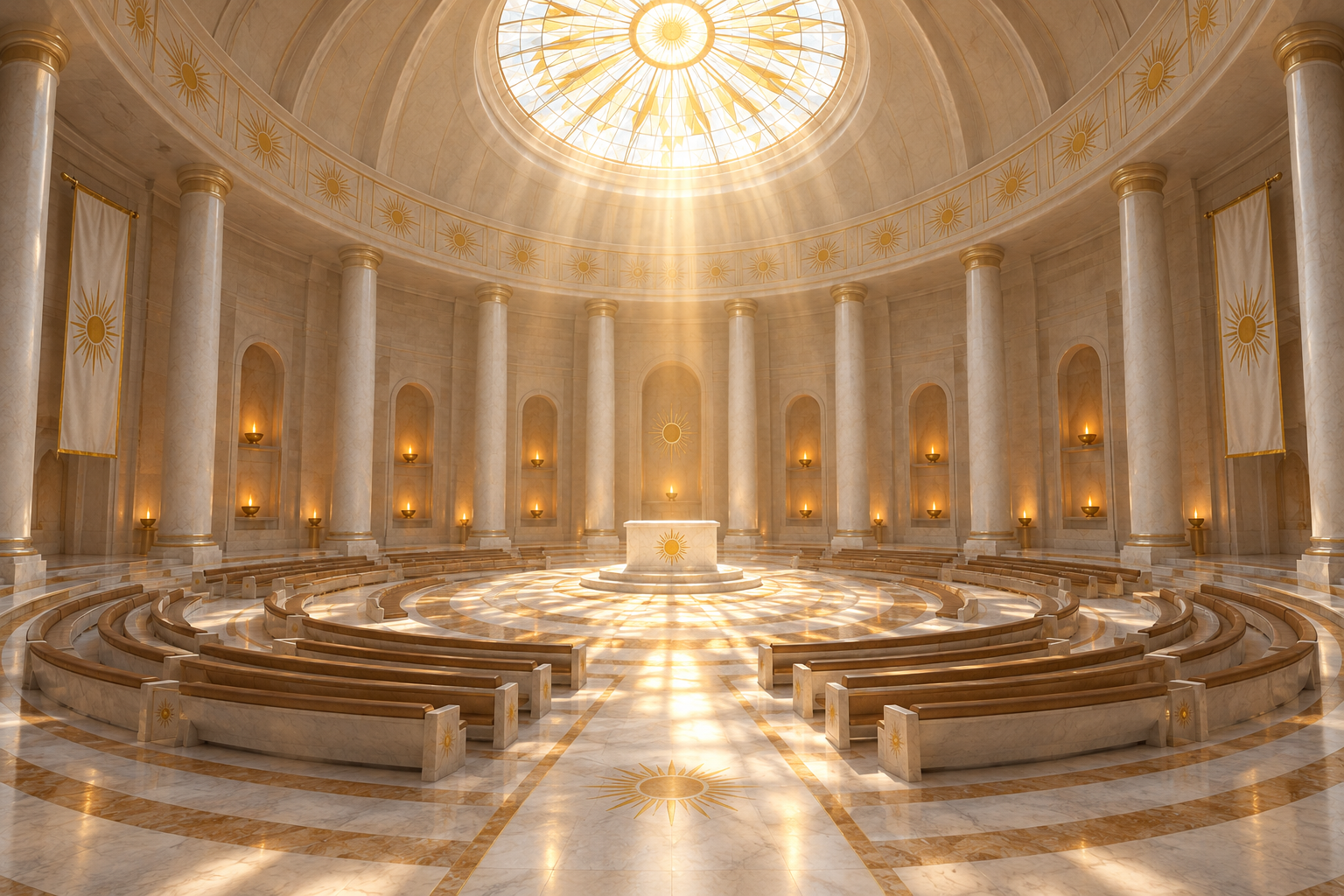
Inside, the round nave opens upward into the dome, which rises to a considerable height. The pillars that support it are spaced evenly around the circumference, smooth and white, and between them the walls curve gently inward as they climb, so the whole interior feels like the inside of a cupped hand reaching toward the sky.
The great oculus at the dome’s crown is not merely a hole but a masterwork of thin alabaster and leaded glass, cut in a starburst pattern so that the light entering it is not raw and harsh but diffused into something softer and more complex; a pool of gold and white that moves slowly across the floor of the nave throughout the day like a sundial writ large. The faithful who come to pray know what hour it is by where that light falls.
The floor is laid in concentric rings of pale and warm-toned stone, drawing the eye inward toward the altar at the centre, which stands directly beneath the oculus so that at midday in summer the light falls upon it.
The altar itself is simple; a single block of white stone, unadorned save for the sun-disc of Pholtus set into its face; because in a room like this, ornament would be redundant. The light is the ornament.
The curved walls between the pillars hold deep niches where oil lamps burn at all hours, their flames steady and sheltered, representing the constancy of Pholtus’s light even through the night when the sun cannot reach.
The overall effect is one of extraordinary quietness; not the cold quiet of an empty place, but the warm quiet of somewhere that expects you, and is content to wait.
Inside the Temple of Light, the centre of devotion to Pholtus in Lyria, a choir was singing a polyphonic harmony that felt unhurried and ancient. It filled the stone space with yearning reverberations, while a solo cantor sang an intoning song over the top of the choir’s foundation. A single, tall figure, wearing a long, light robe was standing at the altar, under the oculus, bathed in light.
“Light and warmth to you,” High Priest Selwyn greeted, and asked the heroes to come and sit with him among the pews. The heroes sat together with the high priest, and after some prodding Emrys explained why they had requested the audience; the heroes were looking for a way to use the Liber Bubonicus, the Book of Woe, to help disrupt and possibly trap Epidemius. For that the heroes wanted to know more about the book, and hoped that the high priest would share any valuable information he might have.
The high priest listened carefully and responded by sharing his belief that the book held no more usefulness. He believed that all possible good had been extracted from the book and turned into the modern healing techniques that were being applied by the priests of Pholtus. He shared that the Monastic Order of Apothecaries, the ones charged with keeping the book safe, had failed in their duties and that the Book of Woe had gone missing. He showed Emrys a scroll with a broken seal;
To His Most Eminent Grace, High Priest Selwyn, Shepherd of the Ecclesiarchy, Servant of the Undying Light
Your Grace, I write to you with a heaviness in my chest that no tincture known to our order can ease. I have read your inquiry three times over, and each reading compounds my shame. The Liber Bubonicus is gone. I cannot soften these words, nor do I believe Your Grace would wish me to.
It was Brother Edric who discovered the vault unsealed at the hour of dawn. The stone seal had been replaced with such care that, to any passing eye, nothing was amiss. Whoever took the book knew precisely where it lay and how it was kept; knowledge that does not belong to any but our own brothers, a thought I confess I cannot bring myself to sit with overlong.
The Liber Bubonicus is not dangerous in the manner of a sharpened blade, which harms only through careless handling. It is dangerous in the manner of a plague; patient, invisible, and absolute in its ruin of those unprepared to receive it. Our forebears among the first custodians learned this at great cost to their minds before mastery could be achieved. What a new keeper may do with it, without that hard-won understanding, I shudder to contemplate.
I have already ordered a full accounting of all within these walls, and I write now to make plain to Your Grace that this monastery places itself entirely at the disposal of the ecclesiarchy in this matter. If it is your will to send inquisitors, we will open every door to them. If it is your will to convene a tribunal, I will present myself before it without delay or condition.
I ask only that haste be made. Every hour the book is abroad is an hour it may reach hands that cannot contain it.
In penitence and in earnest service,
Prior Arturian Venn
First Abbot, the Monastic Order of Apothecaries
P.S. I have enclosed a full inventory of the vault’s former contents, that Your Grace may know precisely what knowledge the book contains and thus better anticipate how it might be misused. I pray it reaches you before worse news does.
When the high priest learned that the heroes were in the possession of the Book of Woe he nearly fainted from shock, and from that moment there was no longer any reasoning with him. The high priest insisted that the book needed to be returned to the apothecaries for safe keeping, and that they alone would be able to keep it from falling into the wrong hands, or driving the people who held it insane. The heroes quietly doubted that the apothecaries were able to protect the book since they had lost it and the book was now in their possession.
They learned that Prior Arturian, the head of the apothecaries, was on his way to Kingsport, and was to arrive either that day, or the next.
Neamhan’s patience ran out and she asked whether the high priest would be able to lend any aid to their cause. He did not respond to her, and continued insisting that the heroes return the book. He took the non-compliance to mean that the book had already spread its corruption to them. Neamhan decided to leave the conversation and walked out of the temple, feeling an invisible hand nudge her along and out into Steward Square.
The high priest believed that the reason why so many in Kingsport were suffering from unexplained and persistent maladies was because of the book’s presence in the city. He rescinded his welcome to the heroes for as long as they would not relinquish the book, and asked them to leave the temple, which they did.