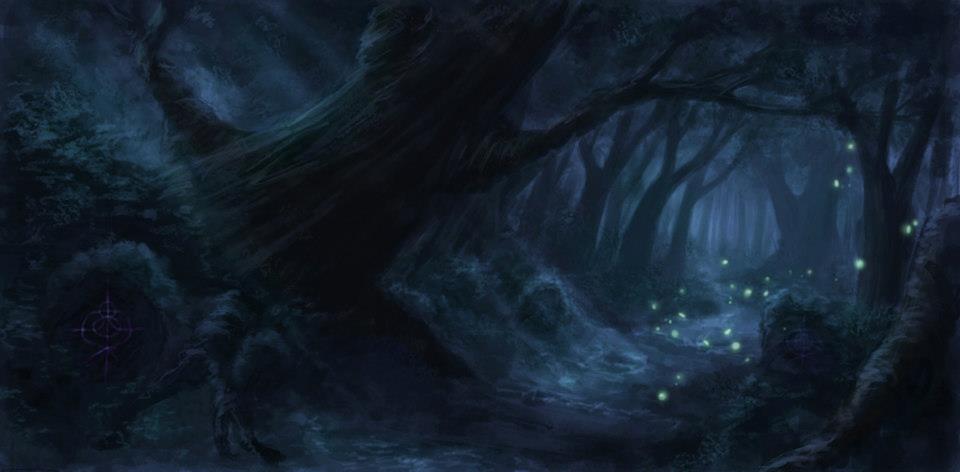
Gaea and the Great Conjunction of Planes

Countless aeons ago, before the Time of Conflict and the Age of Heroes, there was equilibrium and harmony among the Gaean races. The elves lived in the woods and communed with animals, the dwarves mined the earth and worked their forges, and the humans built towns and plowed their fields. Magic was rare and weak, and only really mastered by the elves, who used it to further their connection to the forest and the fae creatures that lived deep within it.

The elves and dwarves were old, wise and experienced. They had mastered the arts and sciences long before humans first appeared on Gaea. Humans often referred to the elves and dwarves as the elders, because of their longevity and because they could turn to them for care and advice. It was a special kind of relationship, like that of a child with its parents. The dwarves were stern like a father, teaching the humans the truth of hard work and perseverance. While the elves were kind like a mother, nourishing the finer things in humans, like curiosity and poetry.

This situation changed when strange creatures started to appear that nobody had ever seen before. Dragons and manticores, werewolves and vampires, wyverns and giants. The worst of the creatures were the demons. The only thing that matched their cruelty was the incredible magic they commanded in battle and their ability to corrupt the hearts and minds of even the most righteous and steadfast.

They appeared gradually and over the course of several generations and upset the delicate balance between the elder races and the young humans. To their surprise, the elves found that with the coming of all these creatures their connection to the weave of magic had deepened as well. Their first instinct was to use that newfound knowledge to retreat deeper into their forests to protect themselves from the chaos. The dwarves learned how to infuse their ore and forges with magical power soon after.  In turn, they used their new abilities to carve powerful runes and wards onto the gates of their mountain fortresses, closing them in horror.

The humans were far too young and too inexperienced to have the gift of magic within their grasp. Unable to defend themselves like the elder races could, the humans quickly found their towns and fields overrun by demons. When they turned towards their allies for help, they found the forests impenetrable and the mountain gates closed. They were turned away. The pain this rejection caused was such that it would permanently alter the way humans regarded the elder races.

For generations the humans suffered at the hands of the demons and magical creatures that ran roughshod throughout the lands. Their homes were burned, their fields were spoiled, their minds were corrupted, their flesh was lacerated and their children were taken. The horrors that were inflicted upon them while the elder races hid in their sanctuaries further deepened the rift.

Their short lives had taught humans to be ambitious and resourceful. So when the rising level of magic finally put it within their reach they started experimenting. Soon after they found themselves capable of harnessing magic enough to start fighting back. Sorcerers found increasingly intricate ways to harness more power from the weave and priests found that their prayers became ever more effective. All within the help from the elder races. It was the first achievement of the emancipated humans.

As soon as the humans started to achieve some minor success in their own defense, the elves took notice. They reprimand the humans for their recklessness, telling them that the humans did not have the wisdom to harness the power of the weave. They argued that exposure to the weave of magic would leave the humans vulnerable to corruption. The resurgence of magic went hand in hand with the coming of demons, after all.

The admonishment was the nail in the coffin of the trust humans once had in the elder races.

For generations the power of magic grew and so did the understanding of it among the different races. They came to discover magic was like the tides; it would roll in and out of Gaea. In times of high magic the fabric that separated the different planes of existence wore thin. Causing rifts or opening up portals between one plane and another became easier. In times of low magic, these rifts would heal and opening portals became much harder.

When powerful demons opened up rifts between to Gaea it caused ripples across all planes. Sometimes these ripples were strong enough to cause small fractures that allowed other creatures from other planes to pass through to Gaea as well. And how the demons reveled in the chaos they sowed.

With their growing understanding of the planes and its denizens, Gaean scholars also started to map the planes and make some startling discoveries. They found that some of the planes and its denizens stood in opposition to others.

The most notorious rivalry was that between the demons from the Abyss and the devils from the Nine Hells of Baator. They had been in conflict with one another in what they called the Blood War since before time began on Gaea. They had long since fought each other to a stalemate on all fronts and what they needed was a new battleground that could break the tie.

And so Gaea was used as a fresh battleground in the Blood War. The first things demons and devils would do when they came through to Gaea was corrupt and sacrifice anyone and anything they could find. The blood fueled their magic, the newly corrupted joined their demonic ranks, their power increased and the Gaean skies darkened.

The humans fought for their survival. Against the magical beasts, against the demons, and against each other as kingdoms, tribes and clans were corrupted to join one side or the other in the Blood War. Powerful artifacts were created, or recovered from fallen demon princes or Baatezu archdukes. Fortresses were erected whose walls were inscribed with powerful warding magics all in service of the survival of the human race.

For aeons the survival of the human race hung in the balance. But eventually the tide of magic rolled back out and magic once again subsided. The rifts in the fabric between the planes started to heal, closing off access to the other planes to all but the most powerful creatures. The humans slowly got the upper hand and most of the demons and devils that were left behind were slain. Inevitably, some of them went deep into hiding, subtly manipulating things in preparation for the next tide of magic to come rolling back in.

The elves reemerged from their forests and the dwarves opened their gates. They found a radically different landscape, with strange creatures inhabiting it. Humans were changed as well, no longer resembling the young race that they had turned their back on. The elder races had forfeited the upper hand, both morally as well as militarily. It would be a long time before magic would be at its peak again, before the races would once again be faced with such incredible evil. Hopefully, it would prove to be enough time to mend the rift between the humans and the elder races.

Serpentswood Motte

Serpentswood Motte. That’s what I decided I will continue to call what we up until now have dubbed the Lizard’s Keep. It’s not the troglodytes’ keep. Upon careful reflection I decided that I would refuse to cede linguistic ground to the idea that it might be. Names are important. It’s why I forfeited my name and chose my own.

And so I choose Serpentswood Motte. It sits on a hillock in a wooded area and it was infested with serpent-worshiping lizards when we found it. The name suits it perfectly. Later, when the keep has been reclaimed and refortified, we can consider renaming it to something less ominous sounding.

5th Day, 1st Ride, 10th Month, 1374th Year

Right before the troglodyte and gnoll forces reached Glister they seemed to turn on one another. Perhaps this already started much earlier, but it was incredibly beneficial to the defense of the town. Their forces withdrew and we could survey the damage they had done, which turned out to be minimal.

Because we had arrived from the east, coming over in barges from The Range to The Hoof, I decided to get some rest in Jago’s hut. I was dead tired and probably wouldn’t have been able to make the trip to Wizard’s Hill without collapsing. Jago and Widukin decided to rest as well, while Quentyn made sure he was seen in and around town. David and his ward prepared to take care of the wounded militia men and villagers.

I am not sure I ever stopped to consider that Jago and Widukin shared a hut together. When we came in and bedded down for a few hours, I remember thinking about it for a few seconds before sleep found me. I don’t quite recall what I thought about it at the time, but now that I have some time to reflect upon it further, I think it’s remarkable. I am not one to cast stones, of course, considering my own history, it’s remarkable because rural people tend to be isolated and superstitious about this sort of thing. In the case of Jago and Widukin they might simply be sharing a hut. They bedded down in separate cots after all, though this could have been a bit of theatre for my benefit.

When I awoke later in the day, I felt groggy and disoriented. I forced myself to get up, and I was once again confronted by the disparity between my body and mind. The fog of sleep was easily shaken from my mind, but the sluggishness that came along with it lingered much, much longer.

I forced myself to eat something that my stomach would accept and would cause any trouble later in the day, and I went through my preparatory ritual. We would be heading back out to Serpentswood Motte to relieve Ser Fosco and the men we left behind, and we’d likely have to cross through hostile territory to get there. Once again, I felt like my frailty was becoming a serious problem and so I spent some extra time reading through the abjuration spells I have collected over time. My collection has grown quite considerably, and I believe it is time for me to focus on some basic protective spells if I am to continue putting myself in harm’s path the way I have in the last few weeks.

Eventually, we all met up back at The Hoof in order to take several barges. It had been decided that the fastest and likely safest course to make our way back to Serpentswood Motte was to go by water. Gilbert, who had the most experience traversing the waters of the Shadowed Lake, arrived in a kayak, ready to lead us east.

Quentyn had assembled another party of able-bodied men to accompany us, and I recognised a few faces in their midst. We divided ourselves across several barges and we started to head east.

After several hours we spotted a large group of ogres and gnolls on the northern bank, lead by the horned ogre. Whispers of “blue giant” went through our group as tensions rose, which irked me. I have read about giants, and from all accounts a giant is to an ogre as a human is to a halfling.

One of the gnolls was carrying a stick with a white cloth attached to the end of it. It seemed they wanted to parlay. Quentyn took them up on the offer and one of our barges slowly made its way towards the northern bank. We had decided to take a smaller group of people to talk, the rest stayed behind on the other barge.

When we came within distance, I noticed that the horned ogre was somewhat smaller than the other ogres, more hunched but with a clear, intelligent look in its eyes. The arcane abilities of the horned ogre was clearly not innate, but learned, like mine. A chill went down my spine as its gaze settled on me for a moment and again, the only thing I could think of was how ill prepared I am in defense.

The horned ogre tried to convince us to give him the bloodstone. The way he put it, he was doing us a favour by taking it from us. That he turned on Oxul’Nitha when she wanted to march on Glister to get the stone. That he saved us and that there were worse things coming for the stone. He could take it away, into the mountains, where it wouldn’t threatened us or the town any more.

Quentyn was in conversation with the ogre, and I tried to remind him of the ogre’s duplicitous nature by softly singing the first two lines from a Cormyrian nursery rhyme about an evil spirit called the Mirrorman;

His smile fair as spring, as towards him he draws you
His tongue sharp and silvery, as he implores you

I don’t know if he heard me, or if his house didn’t have the resources for schooling in letters and literature, or even if this nursery rhyme is perhaps not as common in Westchester. This is the full rhyme:

His smile fair as spring, as towards him he draws you
His tongue sharp and silvery, as he implores you
Your wishes he grants, as he swears to adore you
Gold, silver, jewels – he lays riches before you
Dues need be repaid, and he will come for you
All to reclaim, no smile to console you
He’ll snare you in bonds, eyes glowin’, a fire
To gore and torment you, til the stars expire

When we didn’t want to relinquish the bloodstone to him, he pulled out a large, hail-white stone and withdrew, saying that it would withdraw back into the mountains from whence it came. The stone had some significance, but I couldn’t discern it at the time. I didn’t believe that the horned ogre would depart for the mountains and no longer pose a threat, and so I asked Blackwing to follow him and return to me immediately if it would come close to Glister.

At the end of the day Serpentswood Motte came into view and the troglodyte activity in the area went up. Eventually, I saw a smaller female that I recognised to be Gal’Nutha. Once we docked the barges and disembarked, and talked to Gal’Nutha who was unhappy about us leaving people behind in the keep. I tried to make it clear that were there to pick up Ser Fosco and leave. She wanted to escort us and make sure that we weren’t moving more people into the keep. Also, she wanted to eat one of us in retaliation of what she considered a breach of our agreement.

At that point, I may have lost my temper. She didn’t seem to back down until Quentyn drew Scalebane and Gal’Nutha probably understood that even if she and her warriors would overwhelm us, she herself would be the first to be slain. That seemed to settle things.

Once we got to Ser Fosco, he and the others he was in charge of were visibly relieved. Our extraction from the keep was swift and painless, and everyone felt relieved. Something in the back of my mind kept gnawing at me; we took a major risk in liberating Serpentswood Motte, only to relinquish it to Gal’Nutha because we can’t fortify and hold it over the winter.

The winter. Again I was reminded of the coming of the Frostmaiden’s embrace. I decided to place a cup of water outside of my window to determine when night frost would set in. Many things will need to happen before the first snow falls.

6th Day, 1st Ride, 10th Month, 1374th Year

Night had fallen and we were still on our way back to Glister, when David suddenly asked me if learning magic was hard. Pretty quickly, I realised what he wanted; he wanted one of the townsfolk to go into study with me. I explained that the gift first had to manifest itself and that I could only consider tutoring someone once I had seen the way the dealt with their ability.

The night had been cold but clear and quiet. Calm and peaceful. I was enjoying the boat ride until David brought up the tutelage. The weight of what had been bothering me for months came crashing down on me. I didn’t want to teach, I wanted to be taught! I hardly had time to study myself, let alone offer the proper guidance for someone else. And then I haven’t even address the question of propriety. I would essentially be raising one or more renegade mages.

While I hardly ever saw eye to eye with the Circle of Wizards at the Tower of High Sorcery, I did agree with them that a renegade mage, or a hedgewizard, had the potential to cause a lot of disruption in the realm. I considered myself a starting wizard. Could I bring to graduation someone who I had tutored all by myself?

I got frustrated and angry at the thought of it. David brought it as an essential part of Glister’s defenses to teach someone the mysteries of the arcane. I just saw it as an opportunity for a novice to accidentally burn down a building, or get devoured by their first conjuration, or get absorbed in their own hunger for more power.

I wanted to leave Glister. I didn’t get to study under Marbrand, I didn’t find Marbrand’s grimoires, I stagnated as a wizard and had been distracted by the ambitions of a local lord. On the way over from The Hoof to Wizard’s Hill I confided in Quentyn and shared all my frustrations with him. He has come to rely on me, I needed him to know what was going on with me so that he could prepare for my eventual departure. He was remarkably understanding about it.
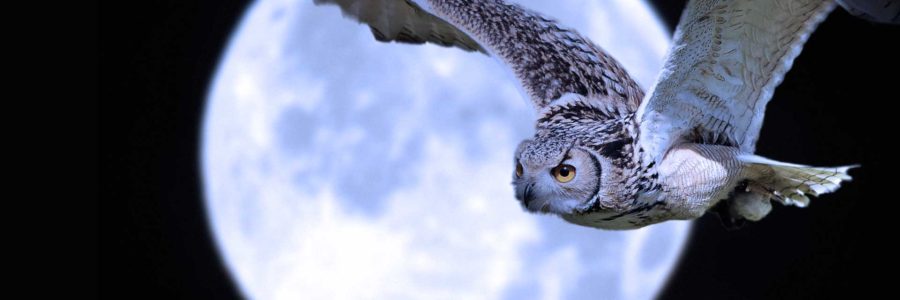
That night I was awoken by soft but incessant tapping on my window. I sat up and raised the lantern that I keep next to my bed and walked over to the window. I saw that on the windowsill, next to an overturned cup of water, which I had left there before turning in, sat an extraordinary snow owl. It was pecking at the window.

My suspicion was confirmed that this was the horned ogre’s familiar and it came to deliver a message, carefully written on a piece of troglodyte skin, carefully rolled up and tied to the bird’s leg. The message was a snide congratulations on being able to hide the bloodstone from him, but also a promise that he would get the stone eventually. He referred to it as his “quarry,” which I thought was remarkable. He also offered the opportunity to get in touch if I was ever in need of it, saying that Blackwing would know how to find him.

I tossed the skin in the flames of the low fire in my room and went back to bed.

7th Day, 1st Ride, 10th Month, 1374th Year

The following morning, at breakfast, I discussed my plans to depart from Glister after the winter. David, Jago and Quentyn were there, and so was Ser Fosco. I explained myself and suggested that I was perhaps to travel onward to the Dalelands, but that nothing was set in stone yet.

David, to his credit, was quick to offer help of finding the grimoires during the winter months. Quentyn reminded me that traders could be persuaded to buy scrolls from Thentia and bring them to Glister for my consumption. I, however, didn’t believe that Lord Marbrand’s grimoires were out there to find in the keep at Wizard’s Hill, otherwise I would have found them already. And also didn’t think that buying scrolls, which is expensive, was going to give me the speed of development that I yearned for. I thanked them for the offer nonetheless.

10th Day, 1st Ride, 10th Month, 1374th Year

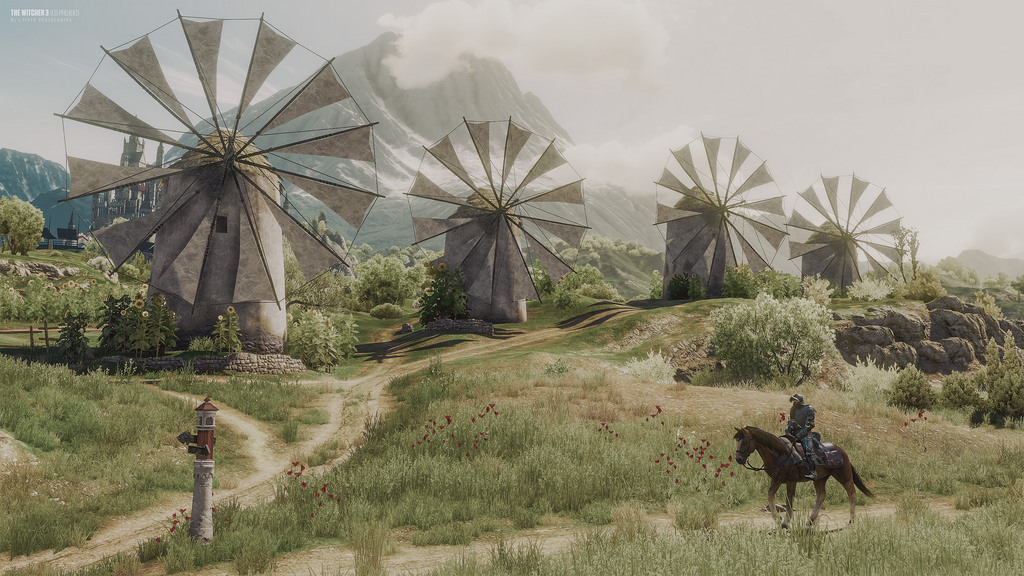
A few days went by and I found myself in the process of making some sketches of a windmill that I wanted to design. I had noticed the winds across certain parts of the Oldmark could be high, which would make it an excellent place for a good windmill in which we could place a large millstone for grinding. It could simultaneously act as a granary.

I already had the design for the internals mechanics drawn up, partly by my own design, and partly taken from different books in Lord Marbrand’s study. The only thing to calculate was the load bearing capacity that the outer framework would need to have, and come up with a pleasing design that was within the capacity of the woodworkers of Glister to accomplish.

To be honest, while Glister could use a more advance grain storage, and could definitely benefit from a windmill, the only reason I was engaging in the mental exercise of designing it was because of the stagnation I feel in my studies. It’s not uncommon for magically talented people with a stellar intellect to seek diversions in matters of engineering and crafting.
There was a knock at the door. It was Quentyn, informing me that two guardsmen had come calling to inform him that a wounded troglodyte had appeared at the ferry across the moat dividing the Oldmark from the Newmark. We decided to go to the ferry together to investigate. The walk was tedious, and once again Quentyn remarked that a couple of horses in the lord’s stable wouldn’t be misplaced.

When we arrived at the ferry we saw a slight figure standing across the moat. She wore a severed troglodyte hand around her neck. Oxul’Nitha. She was severely wounded.

We felt little threat from her, so Quentyn and I, together with two militia men, made our way across the moat by ferry. I was there to translate, but Quentyn did most of the talking. The militia men were commanded to keep an eye on our surroundings.

She came to deliver us a warning; the horned ogre had three stones with entities inside, and it wanted the bloodstone. He had a white one, probably the one that we saw the the ogre take out during our encounter on the northern shore of the shadowed lake. When we asked her where the ogre found the stone, she pointed to the north-west, in the direction of the abandoned mine. Another stone was red, and had been found somewhere on the Thar. The last one was black, and Oxul’Nitha couldn’t say where the ogre had found it. When we asked her where the ogre was staying, she said that it was staying in the mountains somewhere east of the High Pass keep.

The shaman seemed very wounded, tired, and resigned to her death. When she wanted to leave, Quentyn decided that she wasn’t going to steal away into the night for a slow death. He would have her head on a spike, and he drew his sword. Like a cornered wolverine, she fought fiercely! She ultimately fell to the combination of my magic and Quentyn’s Scalebane.

During the fight, she was lobbing small globes of fire at us. The dragonskin doublet made me over-confident, and I stepped in front of Quentyn to protect him, trusting the doublet to absorb the fire. It would have, had I not gotten too close to Oxul’Nitha, close enough for her to swipe at me with her claws. Her nails raking into my skin probably physically hurt me as much as anything ever has, reminding me once again that I was going to have to do something about my own protection soon.
The Conjunction Campaign (Under Construction)

Premise

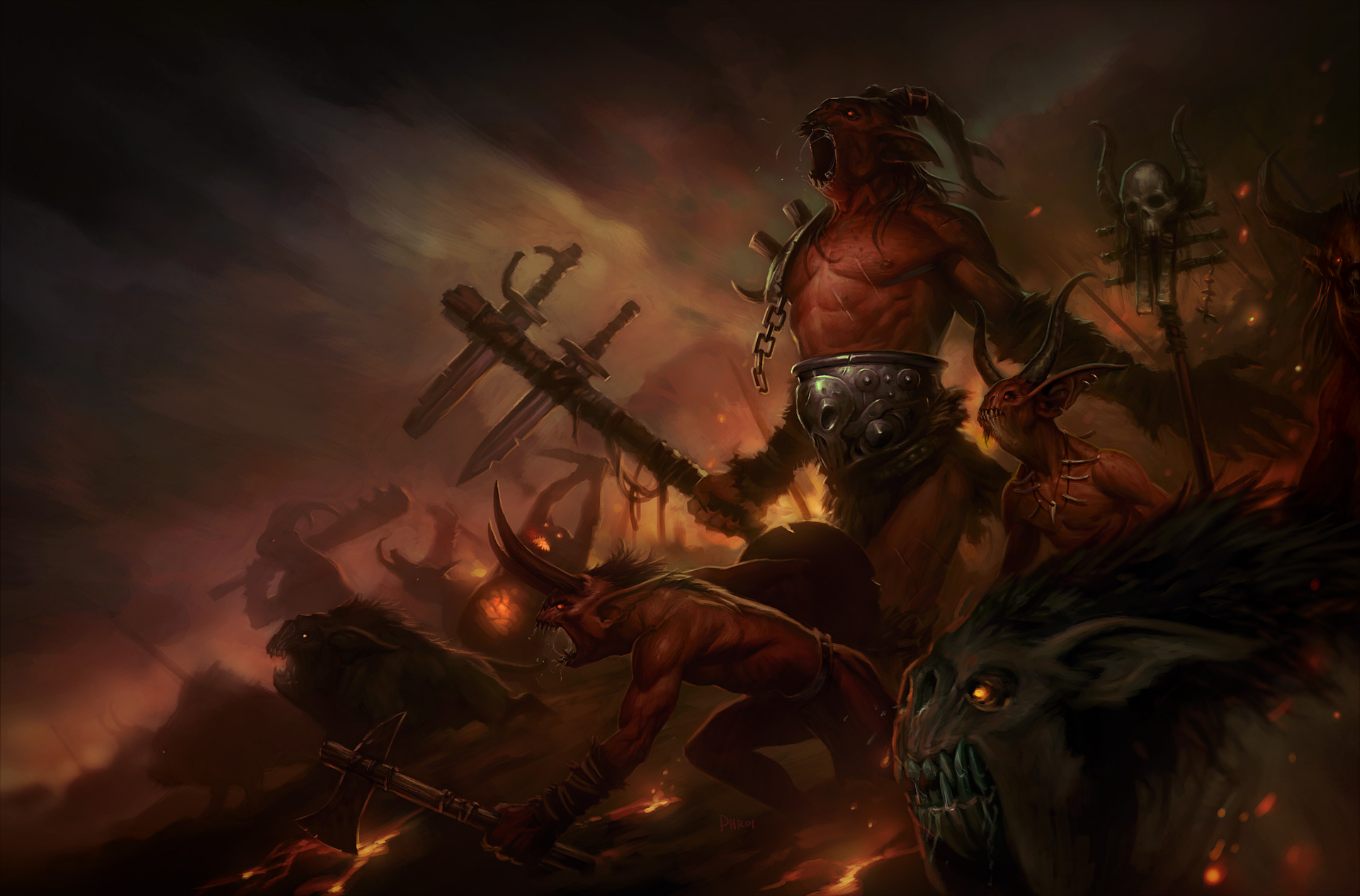
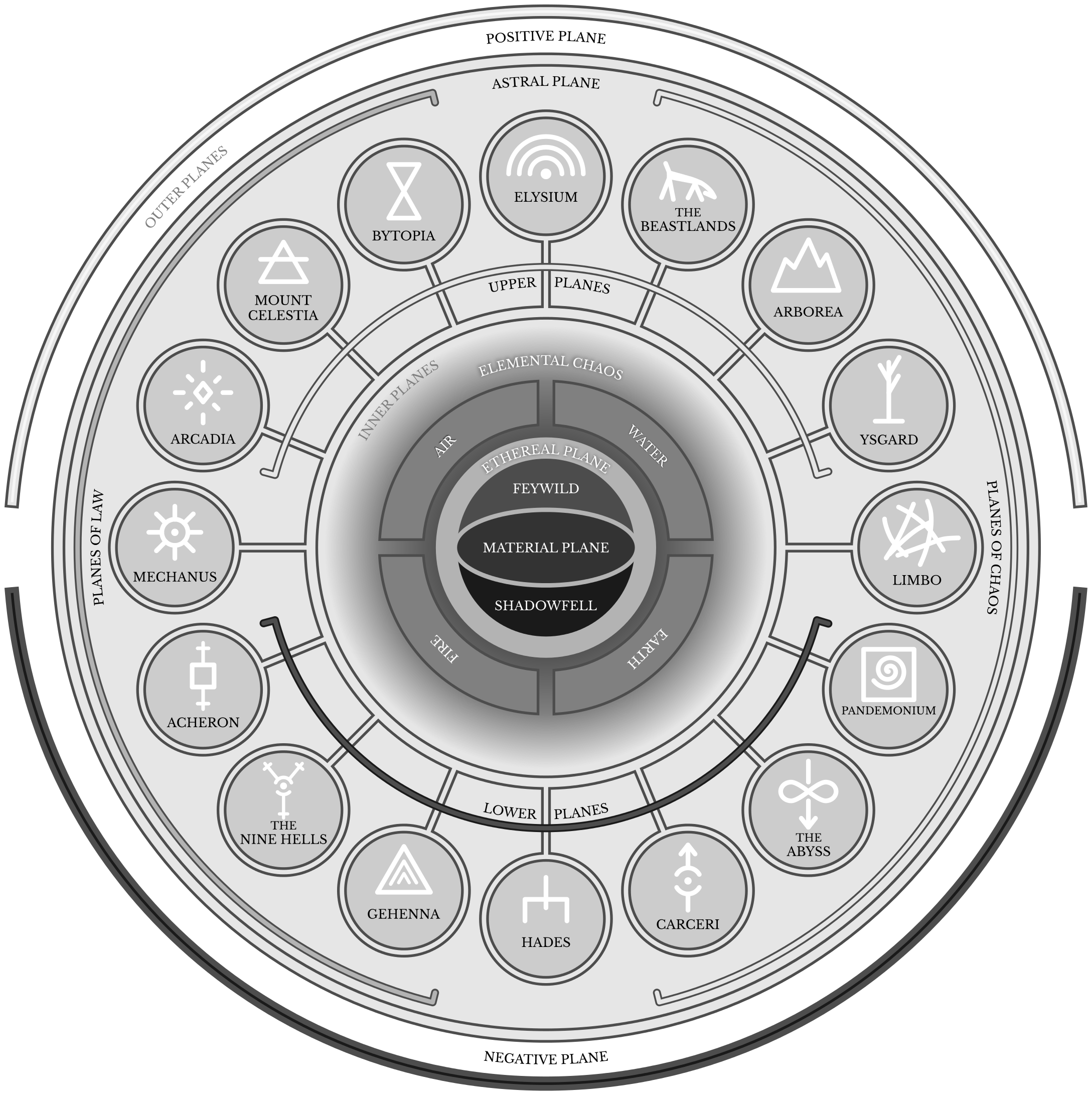
What happens when the different planes of existence occasionally come in contact with each other, where the fabric between the planes tears and allows passage from one plane to the next? What if hordes of demons are working from the Nine Hells and the Abyss to tear open the thin membrane to pass through and wreak havoc and dominate the prime material plane? What if Elysium and the Seven Heavens are working to prevent this? Celestial beings are fighting infernal ones and the prize is dominion over the prime material plane. The celestial forces are more powerful, but far fewer in number. The infernal forces are numerous, but infighting and backstabbing undermine their efforts.

The bleak atmosphere of The Witcher and Ravenloft. The Celestial vs Infernal clash of In Nomine and Diablo. The planes of Planescape.

The Outer Planes

The Conjunction of Planes is a concept lifted from The Witcher’s Conjuction of Spheres. But then using the outer planes model that’s used in D&D.

Outer Planes
Celestia Bytopia Elysium Beastlands Arborea
Arcadia ↑ Good ↑ Ysgard
Mechanus ← Lawful Outlands Chaotic → Limbo
Acheron ↓ Evil ↓ Pandemonium
Baator Gehenna Hades Carceri Abyss

Setting

While it’s tempting to use the Forgotten Realms as the setting, there is too much canon to ignore. We can simply use the outer planes that are commonly used in all D&D settings (adjusted to suit the setting) and build a setting around it.

It would likely start with a rather generic fantasy trope familiar like we see in The Witcher, Lord of the Rings and Game of Thrones, set in a medieval European inspired land set with elves, dwarves, halflings, orcs, ogres, gnolls, etc. In that sense it is not dissimilar to the Forgotten Realms. The big difference is that magic will be far less prevalent than in FR. Magic is potent, but dangerous. Magical items are artifacts from a bygone age and only a select few people have a true grasp of magic and they guard their secrets closely. Common folk are superstitious, follow a pantheon of different gods, deities and powers. They appeal to witches, crones, druids, hermits and pellars to grant them health and good fortune, but fear them in equal measure.

An adventurer who is magically gifted, either with nature (rangers, druids), divine (priests, clerics, paladins) or arcane (wizard, sorcerer, warlock, witches, warlocks, shamans) magic, is a rarity. Warriors, archers and rogues generally found their comeuppance as a soldier in one of the many wars, as a mercenary in one of the numerous companies, or on the cut-throat alleys of the larger cities. The fact that they survived their battles in order to strike out on their own is proof of their exceptionalism.

Character Types and Backgrounds

I think it could be very useful to suggest to players that they should consider a character background where they are somehow an outsider and not part of the establishment. Whether that means that they are magically gifted and therefore both feared and respected, or because they always had a different outlook on life than their brothers and sisters of whatever order they belonged to, there needs to be a good reason why they leave the comfort of numbers and venture out into the world by themselves as adventurers. This is a world where only the gifted and exceptional can make their own way, while others have to band together behind walls and in towns, villages and farming communities. Straying from the village and venturing out into the woods means falling pray to lycantropes. Leaving the undermountain for the surface wilds means getting crushed by ogres and hill giants. Leaving the tops of the songspire trees to walk among the ruins means awakening the dead and ancient evils. There has to be a reason why they did leave their communities, or why they were never accepted in their communities in the first place.

Which brings me to the next point; the players will need to make a very conscious choice to have their character be familiar with, or be a stranger in, the area that the campaign will be set in. If they are familiar with the area, then they will have a cultural understanding of the significance of certain customs, traditions, superstitions and certain legends and lore. Equally, they will likely have a personal stake in what happens to the area. They might fight for friends, family, social redemption, etc. If they are strangers, than they will be regarded with suspicion, discrimination and will likely start off with social penalties. They will probably also have to play catch up when it comes to the cultural and historical significance of certain events.

The DM will provide a general overview of the different areas the story could take place in, hopefully with enough information so that players can make a decision where they would like their character to originate from, and what kind of background they would like to have.

Useful Links

https://en.wikipedia.org/wiki/Outer_Plane
https://en.wikipedia.org/wiki/Plane_(Dungeons_%26_Dragons)

The Lead Character in My Own Tale

Winter, 1374

It has been a while since I seriously considered my future. I have been a resident at Glister for more than two years and I’m beginning to grow dissatisfied with the direction my life is taking.

When I first arrived in Glister, in the spring of 1372, my goal was to convince Lord Marbrand to let me study from his grimoires. Misfortune befell me, and the good Lord Marbrand, for he was found dead the day after my arrival. I got caught up in solving the mystery of his death, the ascension of Quentyn Martell to the seat of the unfortunate late lord’s domain, and the vanquishing and imprisonment of a vicious demon.

From that point onward, I became a trusted counsellor to Lord Martell, helped Glister thrive, expand its influence, and defeat its threats. I’ve made career choices for the good of Glister, and crafted a magical container at great personal expense to further secure the imprisoned demon.

I’ve done a lot for the ones around me. I’ve done a lot for Glister and its people. But I’ve stagnated as a wizard. With the exception of a handful of scrolls liberated from the High Pass Keep, everything I’ve learned was self-taught.

I never did find Lord Marbrand’s grimoires.

While I have settled in as best I could, the people around me don’t take me seriously. They see me as a tool. I’ve not made any real friends, or any real connections, nor learned anything that I couldn’t have learned elsewhere.

Quentyn cares only for his advancement as a lord. I’ve been useful enough to him that he allows me to stay at the mansion, but he considers me nothing more than an obedient court wizard whose arcane forces he can apply as an answer to the question on how to further his success. My presence lends his rulership some allure and legitimacy. He completely neglects the work I put into optimising the crop yields, the time I put into working through the ledgers in order to figure out how to integrate the settlers, or what I sacrificed in order to come up with a more permanent solution to the problem of the imprisoned demon.

Truth be told, I hear his Westchester accent and it nostalgically makes me long for home. I have let that grow into a misplaced sense of loyalty. His ambitions of governance were exactly the reasons why I left Cormyr, but these old familiarities drew me to him because they were comfortable and safe. But I do not want to be a pawn in politics. I do not want to be used like a weapon to achieve another man’s goals!

David doesn’t seem to care for anything at all, certainly not my feelings or opinions. He does as he pleases and is as stubborn as a castle wall. In comparison to Quentyn, whom I suspect harbours the same false sense of kinship that I feel for him, David truly sees nothing more than a wizard. As long as my interests are aligned with his we walk the same path, but the instant that changes he’ll set out without me. He has not one ounce of excess sentiment for me. No discussion, no hesitation, he’ll simply keep walking, whether I follow him or not.

David thinks me naive, foolish, dumb or all of the above. He’s so rigid that he takes a dogmatic stance in every disagreement. I intellectually outrank him by a country mile, but I wonder if he realises that. I wonder if he even considers intellect a virtue. I can imagine many situations in which I would help him achieve his goals, but I can’t imagine any in which he’d help me achieve mine.

Jago… I only have good things to say about Jago. He’s kind, loyal, smart, resourceful and caring. He’s been in Glister as long as I have, but he’s entrenched himself deeply among the people of the Hoof. He has become like a brother to Widukin, of enormous value to Quentyn for his ranging and scouting missions and an undeniably good fit among the settlers of Oak Hill.

He has everything a man could possibly ask for in terms of talent and potential, so the only criticism I could have about Jago is that he could do with a little more personal ambition. His aloofness, I suspect, is an attempt to hide his humble and soft-hearted nature. He has had a rough beginning, and I’d wager that a personality like his wouldn’t last very long without the façade on the harsh streets of the cities along the northern Moonsea coast. He reminds me of Olivar and perhaps that’s why I like him so much.

And so I’m stuck with three people with which I maintain unequal relationships. Jago doesn’t care for me the same way I care for him. Quentyn cares only for what I can do to achieve his goals. And David doesn’t care for me at all.

It’s time for me to start playing the lead character in my own tale, rather than playing a minor character in the tale of another. I will try to gather the resources necessary for me to depart after the winter. It will be three years since I arrived and high time for me to find place that either accepts me, or caters to my own goals. Perhaps the great forests of the dalelands, or the tempestuous sword coast beyond. We’ll see.

Nighttime March to Glister

4th Day, 1st Ride, 10th Month, 1374th Year

We camped in between the outer wall of the keep and the broken tower, trying to stay as far away from the stench of the troglodyte bodies as we could. Even after death they seem to ooze an indescribable stench that was hard on my stomach. Jago once again stunned me with his practical sense by building a large, smokey fire to cover up the stench.

We had a discussion about what to do next. We considered several options; going back to join Ser Fosco on the Thar, trying to find the second troglodyte camp, heading back to Glister. Every option seemed to have a strong drawback which kept us from deciding anything. Instead, we decided to go to sleep and make a decision fresh and early in the morning.

One thing that struck me during the conversation was the notion that before we found the carnage at the Lizard’s tower the troglodytes and gnolls had been collaborating. I asked how that conclusion was reached, and Widukin explained that he recalled the gnolls and troglodytes meeting after the encounter at the Stillwater Rapids. During that time I was dealing with a surge of adrenaline and repeated spasms from voiding the contents of my stomach. I had just taken a deep breath of the vile mist the troglodytes were capable of producing, and I was not well. It bothered me tremendously that I had only learned of that encounter then. It changes a few things.

My assumption had always been that the Lizard’s Tower was the base of operations for a troglodyte leader who held tight and merciless control. Our conversation with Gal’nutha reinforced the idea that Oxul’nitha was that leader. Her powers are demonic and more than enough to drive the troglodytes to these acts of aggression. But I don’t believe that she would have enough power to bend gnolls and ogres to her will.

No, a far more powerful force is at work here. I suspect the ogre mage we spotted at the Stillwater Rapids is in charge of the gnolls and ogres and has enlisted Oxul’nitha and her troglodyte followers.

5th Day, 1st Ride, 10th Month, 1374th Year

When I awoke the following day, I quickly began to prepare my spells for the day. I noticed that Gunnar had perched himself atop a section of wall that was left standing. He was performing an augury. Later he said he wanted to return to Glister. He wouldn’t speak with certainty on what augured, but he felt it for the best if he made his way back.

A conversation was had about how to proceed next. A consensus was reached that the men on the Thar would come and take up shelter at the tower, preventing Gal’nutha from moving in and retaking the tower and keep for herself. I volunteered to help the men bring down the goods since I had prepared a lot of arcanokinetic spells. Gunnar would make his way to the ropes that Ser Fosco and the others had prepared for a possible hasty retreat and make his way over the Thar towards Glister.

I took off flying, together with Blackwing. I had yet to really take the time to go flying with her, but it was as exhilarating and energising as expected. The sense of freedom, of opportunity and of mobility was unparalleled. Long have I desired to be able to fly. Since the time where I was bed-ridden as a young boy I’ve dreamed about it. It helps that it significantly relieves the pain in my joints that I feel when walking for long stretches at a time.

Fly
Bo med faal ven
Fly like the wind

Arriving at Ser Fosco’s camp, we found that Sigbart was not doing very well. The bloodloss he had incurred was too profound for him to remain warm, despite a good campfire. It would take a long while before he would recover and to do so he would have to return to Glister. Gunnar, who arrived at the camp a little while later, would take Sigbart, three donkeys, some excess supplies and building materials, back to Glister. I helped levitate the other two donkeys, together with the rest of the men, down to the marshes below the Thar.

We arrived back at the keep around noon. Jago and Widukin had busied themselves in searching for troglodyte tracks. They had found tracks leading south-by-south-east. It was unclear which group the tracks had belonged to, but the going theory was that they belonged to whoever survived the fight at the keep. It lead me to think about the fight again.

The gnolls and ogres are seemingly working together with the troglodytes. I now believe they do so under the leadership of the ogre mage. But they are probably very reluctant bedfellows, and infighting is likely. What if the fight between at the keep was nothing more than a reestablishment of dominance within a loosely aligned group with a common goal? And if so, who won?

After showing Ser Fosco around the keep, making special note about the tunnel entrance through which we sneaked into the keep, we left him and the rest of the men and set off down the path through the forest leading towards the small river. We kept following the tracks that Jago had found and followed them upstream for a while before they lead north. The tracks were essentially heading roughly in the same direction as we had come from, except that they passed between the hill that held the keep and the hill we suspected held another camp.

When we were about middle way between the keep and the other camp Jago reported he had found gnoll tracks which crossed the troglodyte tracks. Jago estimated that they were tracks coming from the keep and heading towards the other camp. The gnoll tracks were freshest, which meant that the gnolls had crossed from the keep to the other camp after the troglodytes that we’d been following had made their way from the keep to the river and back north.

What did this say about what happened at the keep? Were the gnolls victorious? Did they come to the keep to hand out the orders given by the ogre mage and did they enforce them by engaging in battle? Did the surviving members of the troglodyte, now beaten into submission depart for the river only to return north again under orders from the ogre mage?

The tracks continued and we kept following them. Soon after, Jago found more troglodyte tracks coming from the direction of the second camp, joining the tracks of the group of troglodytes we were following and heading north. North towards Glister. At that point I thought Gunnar may have had the right of it.

We continued following the tracks down the path until the path veered off west towards the Thar. Shortly after, the tracks seemed to turn north again, away from the path and up a hill. Another discussion started about what to do next and what the troglodyte actions meant.

David, who had grown very quiet and was unwilling to engage in conversation, suddenly walked off without a word and continued down the path. My guess is that he was tired of the talking, the indecisiveness and confusion. For a man of the cloth he has little patience for contemplation, rhetoric and counselling. He is a man of action. Either that or thinks us all stupid.

Quentyn had given up trying to penetrate David’s reasons for doing anything, and he wasn’t about to run after him. He ordered us to continue following the tracks. I suspected that perhaps the troglodytes decided not to follow the path but continue straight across the hill in order to save time.

Atop the hill we found a clearing where the tracks temporarily got muddled. Eventually Widukin and Jago decided that this had been a site where the troglodytes had met up with two other smaller groups of troglodytes. There were several dead troglodytes in the clearing, whose throats had been slit and hands had been severed. This gave me the confidence to assume that Oxul’nitha was among the group of troglodytes and she was either demanding a sacrifice from the smaller groups who were joining her, or she was preparing for battle and made offerings for good fortune.

We continued on, deciding to skip eating, despite the dying light. Soon after we caught up with David, who had continued to follow the path. This supported my earlier assumption that the troglodytes had cut across the hill in order to save time. We decided to give up trying to search for tracks and simply march for Glister. Soon afterwards, we started hearing sounds coming from the north, coming from the woods that lay more land inward, away from the Thar.

Jago spotted five stalkers along our path, laying in wait to ambush us. We could either fight, maneuver around them. I handed out dollops of the protective ointment to everyone. If we were going to have to fight them it was best we were protected against their awful stench. While we were getting ready to attack, Widukin shot off an arrow, which missed horribly but sent them scurrying away. Clearly they were not interested in a fight where they weren’t able to catch us off guard.

We continued down the path and a little while later I heard some draconic hissing coming from the darkness up ahead. I was trying to make out what was being said, but couldn’t quite hear it without moving in closer. Suddenly we heard drumming of weapons against wooden shields coming from our right, more land inward, and was afeared we were getting boxed in by another group of troglodytes.

We decided to retreat in order to not get caught between the Stillwater Lake and two groups of troglodytes. Soon after we heard a fight coming from up ahead. We heard gnolls resoundingly defeating the troglodytes who we had heard hissing and whispering in the darkness. I had been completely off, the group banging weapons on their shields weren’t troglodytes but gnolls.

Why would gnolls, who shared a common cause with the troglodytes, be attacking the troglodytes? Was their dissension within their ranks? Were they ordered to set an example? Was this another case of infighting? I decided that we needed answers before we could effectively decide what to do or how to proceed.

We snuck back down the path towards Glister and found the corpses of the defeated troglodytes. Further down the road we came upon a group of three brutes, six stalkers and four regular troglodytes. A well-placed fireball took out the stalkers and two of the regulars. The other two regulars ran off, but the brutes engaged. Two of the brutes we cut down with fire and steel, but not before they managed to critically injure Widukin.

Fireball
Ag ko faal toor do Dinoksetiid
Burn in the inferno of the end times

I called for the last brute to be taken alive for interrogation. It took David, Jago and Quentyn to bring the beast down and tie him up. Now it was time to use a spell to read its mind and get some answers!