Over the last few weeks, I’ve been working on a concept for an alternate Shadowrun campaign that I’ll probably get to run somewhere early 2014. Right now, most of the fruits of this labour are a bunch of small disconnected documents with ideas in it, which I’m going to try and expand upon and post here as consistent campaign setup.
Currently, I have no working title just yet, but it’s going to be a non-canon, unconventional Shadowrun campaign in which the fantasy humanity meta-types (orcs, trolls, dwarves, elves) have been replaced by different types of human mutations and magic has been limited to sorcery and physical adepts and changed to psionics. This, of course, has radical consequences for the history, so I’ll supply an alternate history as well.
Another change is that we’ll start transitioning from SR3 to SR4, mostly in the hope to utilise the new hacker/rigger rules. As a result, the year will likely be 2070 or so, but with the alternate history, it won’t really matter much.
Because one our shadow-cloaked assailants got away and others might have still been around, we decided to stay awake through the rest of the night. We searched the remains of the attackers and I found a necklace with a circular pendant, its outer ring purple, the rest filled by black. I felt it had a religious importance, but no matter how much I tried to recollect if I had seen the image somewhere before, I couldn’t dig it up. The rest was as clueless as I was. I decided to hold on to it, which, upon further reflection now, may not have been the best idea. There is no way of knowing whether a symbol of an obviously evil and dreadful god didn’t somehow hold some sway over us.
We covered up the traces of our camp but left the fire burning in the hopes it would distract any other, would-be assailants. We made another, fireless camp several hundred yards down the road and we tried to get some rest. When the sun started to come up, I prepared breakfast while the others inspected the body of the assailant we had taken with us. Of all of them, this one was the least mutilated after battle, although his forehead was caved in by my hammer, it was clear he was just a normal human, albeit with a strange, ashen grey skin. He was wearing clothing that seemed not of this time. Old, ancient even, and ceremoniously pompous-looking. The only real armour he wore was an archaic looking breastplate that Ebon decided to take along with him, probably because it looked expensive. Ebon also lifted a small purse off the man, which held strange coins made from various metals.
When the sun was at its zenith we no longer held the Spiderhaunt Woods to our rightand we moved into the southern tip of the Desertmouth Mountains. I went off trail and found a stream of fresh water for our horses to take some rest.
At the end of the afternoon we reached the top of the mountains from where our view offered us the ability to start plotting our next course. We decided to give the horses some more rest after the arduous climb and found a good, sheltered place with a good vantage point up as well as down the road. I took the first few hours of watch while the others slept. The wind picked up and howled through the valleys. Akadi was with us that evening. The night went by without incident.
Day 8, Ride 3, Month 5, 1372 DR
The following day was windy and chilly. Without too much ceremony we broke up camp and continued travel. I remarked that Akadi would be with us that day and Abel responded with ignorance and derision. He shall have to make his way through life without the gods.
The landscape changed when we reached lower ground. We had to make our way through small canyons and crevices. I’ve been very lucky in finding fresh water for us and the horses, and for that I gave thanks that day.
At a certain point my companions pointed off in the distance toward an onrushing sandstorm. I remarked that this what you get when denying the existence of Akadi, and Abel continued his blasphemy. As if in my element, I quickly found shelter for us. I covered Stygos in several of my blankets and tried to keep him calm.
Ebon’s horse panicked and ran out into the storm. Two hours later, when we had ridden out the storm, the first out of Abel’s mouth was a snide, blasphemous comment. Remarkably, Ebon’s horse was still alive, but barely. It took hours getting Ebon’s horse up and walking again. We moved slowly, but we moved.
Hours later, we came upon a city — the city from my vision! The darkness I had seen was there, too, writhing and moving constantly. It was a horrifying image, even more so than in my vision.
Ebon and Thorim spotted a group of people close to the city. It was likely they had seen us as well, but we thought it prudent to make camp and investigate the following day. The fear was that the people would be hostile to us. The watch remained uneventful and we awoke without incident the following morning.
Day 9, Ride 3, Month 5, 1372 DR
During breakfast Ebon revealed he had spied on the camp outside Tilverton and counted less than a dozen campfires. Abel started diguising himself quite convincingly with Ebon’s help. I asked what the likelihood was that he would be recognised and he said he didn’t think it likely. He also thought it unlikely there would be any repercussions for us if he would be recognised, something which Thorim clearly didn’t believe. He also revealed that Abel Silver wasn’t his real name. Something I hadn’t ever considered before.
We carefully headed towards the city and spotted Cormyrian banners. Ebon decided to scout ahead and spotted between thirty to fourty people, mostly soldiers but also sages and wizards. The darkness in the city was deep and eerie.
We were met by a group of purple dragons, which is what Cormyrian knights call themselves, apparently. They asked our business and ended up escorting us to their commander when we told them we were investigating the happenings on order of Lord Morn of Daggerdale. Their commander turned out to be a woman by the name of Caladnei. She was very serious and none too happy with our presence or our attitudes. Well, mostly my attitude. She rubbed me the wrong way, so instinctively started mouthing off, something I regret doing now.
She and hers had been there for a ride and had sent several excursions into the city, only to have the troops return mad and gibbering. She claimed no form of magic was capable of working close to the city, and when I tried the simplest of prayers, Abaddon never responded!
The discussion didn’t prove to be too fruitful but we gave the items we lifted from the ashen men that attacked us. I asked after Heron but nobody knew about him or had spotted someon resembling his description. Ebon managed to swap his horse out with another while Abel and I put our ear to the ground, but unfortunately we both came up empty.
Much later than desired, we finally hit the Tethyamar trail with Thorim in our company. I was glad to put Dagger Falls behind us and finally set out. We were wished a safe travel by the guards at the ford as we waded through the cold waters and as if wanting to hammer the very point of my departure home, they called me “Lord Leman.” Unfortunately, as soon as we set out we got waylaid.
Just outside of town we found a group of farmers, surrounding a body of a man laying in a ditch along side the road. The body belonged to a guard, one of the Freedom Riders. After other Freedom Riders arrived, they confirmed him to be a guard stationed to the south, at Anathar’s Dell. A quick look at the body it appeared he had been attacked from behind and stabbed to death; several to the back, one to the throat. None of the farmers had seen anything, having just found him here in the early morning. A quick search of the surroundings also didn’t reveal anything, which didn’t surprise me. He hadn’t been jumped by brigands, the wounds were too precise. Nobody with the skill to wield a blade with that accuracy would be so careless as to leave clear traces for us to follow.
The decision didn’t come easily, but I felt it had to be done and ultimately I let Abaddon decide whether the situation warranted it, so I tried communicating with the departed.
The Rite of Selection is an ancient tradition in the priesthood, usually performed right after a large battle. The fulgurator, or “he who reads the signs in lightning”, would sift through the detritus of battle, bringing a merciful death to those who were suffering needlessly, binding the wounds of those who endured and looking for signs of great endurance and struggle. A good fulgurator could read the signs of war, could find a fallen warrior surrounded by a heap of dead enemies and follow Abaddon’s guidance to finding a worthy disciple. The fulgurator would kneel at the body, lay it on its back, open their eyes to the heavens and place their weapon back into their hands and ask Abaddon for communion. In a few questions, the fulgurator would confirm whether or not he read the signs correctly, whether the warrior could and would be a son to Abaddon.
This isn’t the way I thought my first communion would be. Then again, I’m an archon, not a fulgurator. I don’t have the patience that my mentor Heron had. I am a filthy mercenary at the core, not a teacher and sheppard. No lordly title nor an expensive horse under my arse will ever make me forget that. I was never meant to perform the Selection, but it gladdens me to know that Abaddon will allow me to do so, perhaps in the future. I was also somewhat surprised and overjoyed that Abaddon blessed this act when performed on the dead guard. I decided to take it as a sign.
Communion with the dead guard was a powerful and dreadful experience the likes of which I am unable to put down in my journal. Every time I think I have found a way to describe the sensation the words come out wrong and I tear up the page. Instead, I will simply note what it was that I found out; the guard was sent from Anathar’s Dell to Dagger Falls, in order to warn Lord Morn that Tilverton had fallen. He was stopped by a man with a dark cloak and hood and attacked from the rear by a similarly dressed man with a knife. He also mentioned the two men wore a circle on their clothing, which I have interpreted to mean that it was a symbol of some sort. Sifting through my knowledge of regional mercenary bands, I came up empty, and there are too many priestly orders that use the circle to represent themselves.
We decided to return to Dagger Falls and speak to Lord Morn. He was shocked and immediately requested us to depart for Cormyr and investigate the situation. It has struck me as troubling that now that we were part of the noble peerage of Daggerdale that there no longer was any talk about compensation, no talk about recompense. He phrased it as a “request” but used his lordly voice to command us into going. I didn’t like it, but since we were heading in the direction of Tilverton anyway, we decided to accept the charge.
When we returned back to claim the body of the dead Freedom Rider, the other guards had since recovered his horse, which had been standing somewhere off in the distance. Before bagging the body and placing it upon his horse, I performed the second part of the Rite of Selection, which I was fairly confident Abaddon would grant me at that point; the preservation. After the communion was over and the fallen warrior had accepted the Lightning Lord’s offer of ressurrection in His service, the body would need to be healed and preserved. There is probably a more dogmatic reason for the preservation, but I always thought that a newly resurrected son of Abaddon wouldn’t be so happy with a rotting corpse as a living shell. So with Abaddon’s blessing, the body wouldn’t whither and decay for a while, giving us enough time to return him home to Anathar’s Dell without him stinking up the place.
The weather turned wonderfully foul, with thick rain clouds rolling in overhead and my spirits were lifted considerably as Abaddon smiled down on me. I had done well that day.
Later that day we arrived at the Ruse’s Mage at Blackswitch and found it packed to the gills. We managed to snag the last two rooms and after giving the stable boy my instructions to care for the horses but to leave the body bag untouched, I spent a while praying on a hillock overlooking the village pond. It’s the same hillock where I’ve prayed everytime I’ve been to Blackswitch. It’s the hillock where I decided to invest some of my earned gold and look for a suitable horse, which eventually lead me to my trusty Stygos. I’m fond of that hillock for reasons I can’t quite put into words. After prayer, I went back inside the inn and ordered to mugs of black foam and peeled my soaking wet clothes off. While the inn was busy, it was filled with locals with locals fleeing the rain and no travellers we could ask about the situation down south. After food and plenty of drink, I went up to go and sleep. The only entertainment in the room by that point was Thorim recounting stories I had already heard or was part of. Bah.
Day 5, Ride 3, Month 5, 1372 DR
It was still dark outside when I woke up from a disturbing dream. I had seen Heron riding a horse in dusty, rocky hills I didn’t recognise. I also saw a fair sized city I didn’t know, which, upon reflection, could well have been Tilverton. A strange darkness descended from overhead and started to envelop the city and shroud it in blackness. I opened the window and stood and stared out into the turbulent darkness while Thorim was still snoring away in his bunk. My meditation was broken hours later when Abel walked in to wake us up. Morning had come.
Before heading down, I kicked Thorim’s bed with enough force to receive some signs of life. Downstairs I gave Delward the universal sign of food. He brought food. Abel was quiet and annoying. I felt good due to the thunderous weather, but I had so much on my mind that I kept to myself. After breakfast we unceremoniously departed and headed back down the Tethyamar.
At the end of the day we reached Anathar’s Dell and we headed straight for the Freedom Riders’ garrison to return the body of their fallen brother. The last time we were here I remember they had elves astride large hunting cats, but this time I didn’t see any as we rode in, probably hiding from Abaddon’s blessed storm.
When we delivered the body to the garrison we got a disturbing report that Tilverton had disappeared in its entirety. The tale sounded fantastical and without too much merrit, but it did coincide with the dream I had the previous night. I was so distrubed by this that I went to talk to Abel in his cottage after we had taken lodgings at the Anathar Arms. I told him about my dream and his mind being obviously more keen than mine started to try and make sense of it all. His conclusion was as fantastical as the story about Tilverton’s disappearance, and one that I will only share with you, the reader, once two conditions are met; first, we need a little more proof and second, I need to actually understand it in order to convey it you.
Day 6, Ride 3, Month 5, 1372 DR
Disappointed of not having been granted another vision, I woke up to calm weather. Had the weather previously picked up and acted as a messenger, delivering Abaddon’s vision to me? Or had the weather died down to show me that I was heading down the wrong path? A fulgurator would have known how to interpret the signs. I need Heron now more than I ever did before.
I visited the Brightblade clan’s smith, an old greybeard that had done some work on my armour when I was here last. He remembered me. My thought was to invest my money into getting an upgrade in armour; I would rather have my back shattered by plate armour than by a sack of coins. Unfortunately, the greybeard didn’t have anything that suited my needs or fit my body, which was unfortunate, but it was good to practice my stale Dethek when talking to him.
Halfway into our day we stumbled upon a merchant of homestead utensils and non-perishable foods. He told us about the turbulent state Cormyr is in. He didn’t pass Tilverton because “the stonelands” were beset by savage raiders. We stocked up on food and moved on. He had three guards, so he was obviously making good money selling food. Delward at the Ruse’s Mage had said that the harvest would be a bad one this year, meaning food supplies would be low. The merchant was a war profiteer. I hate those. May the people of the dale persevere through that type of opportunism.
We made camp off the trail and spent the night under the stars for the first time in a long while. Roland no longer being around, food wasn’t as good as the last time, which is why I invested in bringing good food along. I caught first watch, which went by uneventfully.
At the tail-end of the second watch I was woken up because Abel’s silly pet cat had spotted something approaching camp. It all went very fast but four or five humanoid creatures, clad in dark… armaments, cloaked in the essence of darkness itself, attacked us. We defeated them with overwheleming force and not too many problems. I was trying to reason with them but they wouldn’t listen. After the battle, Abel remarked how they resembled the shade who took the orbs from us at the Teshford Arms all those weeks ago. He also remarked aloud whether the darkness didn’t have something to do with my vision. He was finding more evidence to support his theory. We’re not there yet, and I certainly don’t understand what’s going on, but soon I will have to write down what Abel thinks is happening.
I find myself stuck in Lord Marbrand’s library again. I have to research our likely adversary, Nar-Narg-Naroth, while the rest are out hunting for the cultists. Weighing the benefits of being surrounded by such a wealth of knowledge against the drawbacks of slogging through the mud in the forest or sloshing through the brackish water of a partially submerged ruin is slowly becoming impossible. In essence, the difference is searching for second-hand information in books, or searching for first hand information out there. If Lord Marbrand had occasionally left the library and had gone out there to find information instead of have books brought to him, his notes wouldn’t have been so dull and he’d have much more to show for it. It took us a little over fifteen days to find out the name of the creature buried in those catacombs, something that he was never able to uncover.
Regarding Nar-Narg-Naroth, I’ve unconvered much information. To my dismay, I also found that we’re dealing with a rather overwhelmingly large outsider called a Bebilith. This means that my earlier assessment that we were dealing with a Baatezu (devil) was entirely incorrect, but that it’s in fact a Tanar’ri (deamon). The distinction is important, you see. Baatezu are structured in their infliction of evil upon reality, with a strict hierarchy within their ranks, making them arguably much more dangerous to our existence than the Tanar’ri, who are more chaotic and unpredictable. A Baatezu is much more likely to inflict precise, systematic destruction, while a Tanar’ri will more likely engage in wanton destruction and despoilment. They are also less organised and fewer in number, but that which they lack in number they make up for in raw power. These two factions have been waging a war against one another older than living memory. Baatezu against Tanar’ri, the denizens of Hell against the denizens of the Abyss. And according to all accounts, they have fought to a stalemate, an equal match between discipline and numbers against raw and brute strength.
A Bebilith is a huge, spider-like deamon, who hunts and devours other deamons. Known as “the creepers of the Abyss” and “barbed horrors” and considered to be the cruel harbingers of death and torture to anyone crossing their path. They are eight-legged arachnids, with a bulbous, chitinous body and two pronounced forelegs which end in brutal barbs. Their fangs secrete a poison and they are preternaturally tough and capable of shooting sticky strands of webbing capable of trapping and suffocating men. Their senses are razorsharp and while they understand the gutteral language of the Abyss, they communicate through a powerful sense of telepathy.
It seems Nar-Narg-Naroth is one such Bebilish, but it has been reported missing from the Abyss for hundreds of years, likely because of its imprisonment in the catacombs underneath the Thar.
I’m bored of reading up on this deamon. I think I’m going to try and put my time to good use and enhance my repetoire of spells. Also, I’m going to continue exploring the possibilities of the dragonskin vestments we found. I think that will be of greater value to us in the coming fight than knowing the multitude of ways in which this Bebilith can kill us. If it had any weaknesses that I could’ve learned about in this library, I’m confident I would have found out by now. Now that would be an amusing epitaph to put on my headstone, provided I don’t get devoured by Nar-Narg-Naroth.
It’s been several days since I was in a position to take the time to write. A lot has happened but no progress has been made, so I’m using the tip of my quill to force my mind to focus, to catalogue, to reference and hopefully to reveal. I find myself going over the same information, dismissing, sorting and prioritising the same things and drawing the same conclusions. I need to force myself to write as much down as I can recall and reevaluate everything.
While I spent most of the days following Lord Marbrand’s funeral investigating the blood ties between Quentyn and the late wizard, I asked Jago if he could go back to the Thar and see if he could pick up any tracks the three white-robed figures might have left behind. David and Quentyn initially decided they would help me excavate the riches of Lord Marbrand’s library in search for clues regarding the Draconic phrase that was written on the piece of paper recovered from the mouth of Lord Marbrand’s corpse.
“That which is not dead can eternally lie, and with strange aeons even death may die.”
Unfortunately, while both men are in peak physical condition, they have little endurance when it comes to prolonged research and studious attention. It doesn’t surprise me this to be the case for Quentyn but David is unlike most clerics I’ve known. The servants of Chauntea, under whom I was tutored for a short period, were mildly studious, but it seems David has the bearing of a man more fit for combat than pious contemplation. The two men eventually joined Jago in search for signs of the three white-robed figures and left me with Lord Marbrand’s research and correspondence.
Lord Marbrand seemed to be poly-maniacal about his research, never focussing on one subject at a time for very long. He was also deeply chaotic and scatter-brained, his works and notes lacking any of the modern structures taught in any college worth their merit. He, like many wizards of his generation, were under the impression that as long as they were able to understand their notes, their work was good enough. It never crosses their minds that they might be doing their research harm by not applying a proper, formal structure, and that they could have increased their productivity and insight with the right psycho-spiritual conditioning.
I managed to find the following, relatively recent, fields of interest to Lord Marbrand;
History of Glister. There is quite a bit of correspondence with scholars and sages, mostly from Candlekeep, Waterdeep and Thentia.
Lineage, both of his own family as well as others.
A rather deep and involved debate with a Brother Martinus of Candlekeep about the nature of the many stone structures and ruins on the Thar. It seemed to have ended in a disagreement which lead to petty bickering and name calling.
Two schools of magic seemed to have caught special attention from Lord Marbrand as of late; the schools of Divination and Conjuration, and especially the relationship between the prime material plane and other planes.
When the others returned from the Thar, they told me they had followed the tracks of the three white-robed strangers north, off the Thar and into the woods, ending at a small, abandoned camp. Besides the remains of a small campfire, they found, buried in a small hole, the body of a decomposing rabbit, buried with a flat stone with the crude symbol of two white hands on it, with interlocked thumbs and fanned out fingers. I have since found the symbol to belong to Yurtrus, the orc god of death, disease and annihilation.
I just had a small revelation, which seems to suggest that my initial suspicion that I had overlooked one or more things was correct. White seems to be a colour of importance to the followers of Yurtrus. Their followers are white-robed, their symbols has consistently been two white hands — whenever we found the symbol scribbled in walls, it was always coloured in with white chalk. Could it be possible that the pouches of silver, given to the gnolls to attack The Hoof and take Wulfric’s daughter, were white not through chance but because it was the pay-off from the Yurtrus clergy?
At the time I decided to let the arrival of three of Yurtrus’ followers not distract me from delving deeper into Lord Marbrand’s notes on magical theory, particularly his research into the planes. He speculated that killing something not native to the prime marterial plane, on the prime material plane, might lock its essence into a strange stasis. As an example, he theorised that the great glacier was a frost giant demi-god. He never spoke about experimenting, which was further supported by the lack of a summoning circle in his library. Wizards who experiment with summoning and conjuring, usually take the time to invest in a secure circle, which is then not something you clean up after use, considering the time and monetary investment it involves.
Regarding his research into his own lineage, it seemed Lord Marbrand significantly oversimplified things in his letter to Quentyn. He makes several spurious connections and draws questionable conclusions. I managed to retrace Quentyn’s lineage from Cormyr to Sembia and eventually to Impiltur and then Vaasa. As I retraced the steps, the name Martell morphed to Martyl and eventually I found a very interesting fact; Harren’s Demonsbane, a disgraced, vagabond member of the Martyl family, was thought to have erected a stronghold just north of the Thar, in the foothills of the Galena mountain ridge.
The evidence seemed to indicate that Lord Marbrand did not have a rightful claim to Castle Glister, as no connection between his House Marbrand and House Martyl can be established, but he arrived here and found the village dwindling and took up residence. So it seemed to me that Quentyn, while the rightful heir to the castle, wasn’t the rightful heir to any of the wizard’s belongings. It could be argued, however, that Quentyn’s father is owed some restitution for Lord Marbrand’s occupation of his castle.
I grew tired of genealogy and decided to switch my attention to Yurtrus. At the same time, my companions had gone into the woods to seek out gnolls, hoping to find out more about their connection to the events leading to the wizard’s death. It turned out that Lady Ulrikke and her companions had done the same. The two groups met up in the woods and Lady Ulrikke had captured a gnoll, which she was leading back to Glister for punishment. David, granted the power to commune with the gnoll from his benevolent god Ilmater, had heard the savage say that it made no matter that he was going to be executed because “the pale shadow” was going to come for us all. So when I looked for a connection between Yurtrus and “the pale shadow,” I found that these were a nihilistic sub-group of the Yurtrus followers. It seemed that the gnolls had started to worship an orc god. Not unheard of, but rare. I once met a man in the Dalelands who was a follower of some ridiculous Halfling god. Again, it happens, but it’s quite unusual.
I went back to study Harren Deamonsbane to find that almost three hundred years previous, Deamonsbane and several companions defeated a deamon on the Thar. It turns out Lord Marbrand had done quite bit of research into the man since he had managed to find a stone lockbox carrying Deamonsbane’s personal seal; a sword upon a plain red shield, which has a striking similarity to the heraldry born by Quentyn’s house. We were completely unable to open the box, with magic nor force, but it was clear the box was magical. A small depression in the top lead to a hole which could well fit a slender key.
I felt the research had been concluded to large extent and decided to take some time away from the library. It would serve me well to have some concrete questions that need answers, and at the time, we were aimless. Arriving back at the inn, I noticed several new people had come to town. A trading caravan had arrived from the north, the same caravan that Fergal, the caravan master I had come into town with from the south, had been waiting for since our arrival. The biggest pleasant surprise was that one of their guards was a dwarf, his name Gorm of Clan Dwalin of Svetislav in Vaasa. A bit taciturn at first, but in the end a very engaging conversationalist.
I paid Haéla the laughable sum of two gold pieces for another ten days of my stay at the inn. I managed to catch Lady Ulrikke for a short conversation about Yurtrus, the pale shadow and the implications of the three robed figures we saw upon the Thar. She knew about the orc god and seemed to keep an open mind to the possibility of a small group of nihilistic cultists being responsible for the death of Lord Marbrand. On a separate note, I tried to gauge her on which way she would vote; for Quentyn or against. It was impossible to read her — not the first time I’ve had trouble reading her, which is most unfortunate. I tried to convince her of my belief, which is that the village of Glister, and its sphere of influence, is best served by a magnanimous, benevolent and wealthy force, like Lord Marbrand, instead of having that wealth distributed and diluted among many different and sometimes rivaling factions. I told her I thought Quentyn could fill the vaccuum that Lord Marbrand had left behind with his untimely death. She neither agreed or disagreed, nor gave any indication on what she was thinking.
It has previously occurred to me that there are a lot of different forces at play on the Oldmark. If I am to navigate this political landscape, as unsophisticated and small-scoped as it is, I need a way to be able to read people better. I think I will start taking the time to go through Lord Marbrand’s library to see if I can design a spell that will allow me to read the surface thoughts of others. I’m fairly certain that lies within my capabilities. Once I can do that I can built on that basis and further expand my abilities. It would greatly help me understand and predict the people that I’m exposed to.
The following day, I was asked to join Jago, David, Quentyn and Harald, who were going to head out to the Thar to find and vanquish a horrible troll that attacked David and Jago a few days previous. I wasn’t too keen on sleeping outdoors, but if all went well we would visit the barrow to the south of Glister. I reckoned the trip would be worth it if we could explore the barrow.
The first night on the Thar was very, very cold. Cold and uncomfortable, not the least because a troll showed up and attacked our group. The fight was short and brutal. Afterwards, Harald cut the troll’s heart out and threw it in our campfire. I had heard of mountain troll’s ability to quickly regenerate any wounds. Harald explained that even after killing a troll, it could regenerate all the way back to perfect health within no time, lest you burn its heart, after which it would quickly petrify and turn hard as rock.
Day 10
I woke up at the tail end of Harald’s watch. I don’t know how the man does it; it seemed like he was praeternaturally large and hardy and even though he took a beating while fighting the troll, excerted a tremendous amount of energy swinging that awful weapon at the head of that troll, and had walked the Thar for a full day, he still took a big chunk of the watch. He is a man of few words and a bit stereotypical at first look.
We cleaned up camp and headed off, walking for two hours until we found the remains of a very old, moss-covered road made of hard, large slabs of rock. The road was about three meters wide, running from the north-west to the south-east. We followed it towards the south-east and Harald claimed that if we had followed it to the north-west we’d find a different, but similar barrow. It’s likely there are roads running between different barrows or structures. Along the road, we found several standing stones, often quite similar to the ones in Glister. We even found an old, petrified body of another troll corpse that Harald defeated nearly two years before.
After so much walking my backpack started to chafe and a headache had developed, starting at my shoulders and creeping up along my neck to my scalp. Looking around, I noticed quite a large number of useful herbs among the rough bushes on the Thar, but unfortunately none of them were going to be useful in getting rid of that headache. I made a mental note that I should go on an expedition to forage and catalog the herbs when things quieted down a bit.
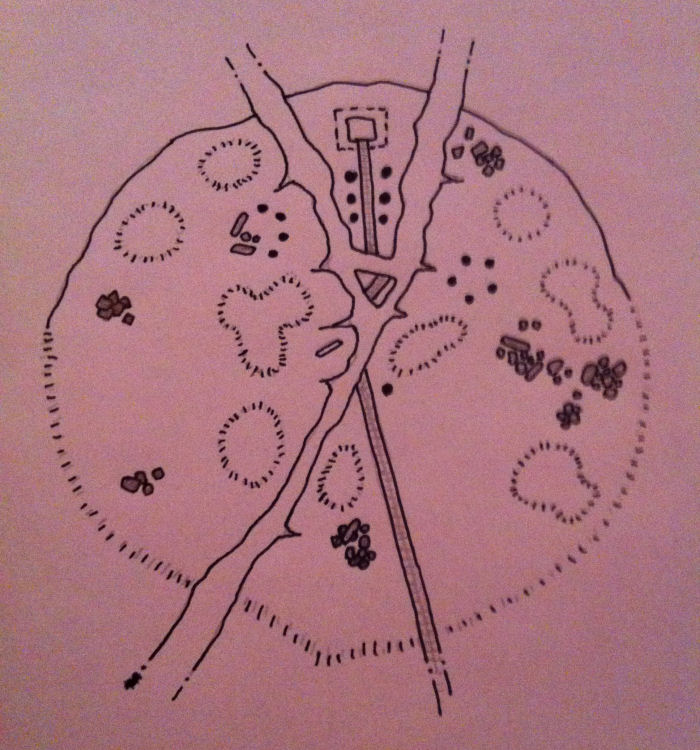
The barrow on the Thar, south of Glister.
When we arrived at the barrow, a sketch of it pictured above for reference, it looked long abandoned. The age of the structures was apparent from the copious amounts of moss growth and the crack that ran along it like a scar, as if split apart like wood being subject to the large temperature differences between day and night on the Thar. Curious as to how deep the crevice ran, I reached out my mind to Blackwing and kindly requested her to fly the length of it.
That may have been a mistake. One I attribute to my relative gullibility and over-confidence when it comes to the dangers that lurk in the dark and hidden places of the world. I sensed overwhelming fear, distress and frustration emanating from the deep trench and foolishly rushing over I quickly understood the nature of it; giant spiders. Blackwing had caught on the webbing of these despicable creatures, black and green with a hard chitinous shell protecting their thick, bulbous body.
Several spiders surged upwards while I descended down into the crevice to free Blackwing. I feel obliged to mention my experimentation with the Feather Fall and Mage Hand incantation had yielded such results over recent weeks that I managed to unlock the secrets of levitation, allowing me to ascend and descend at will for an extended period of time. Lateral movement is still a problem, but I am very confident that it won’t be so long until I can move freely in any desired direction.
Levitation
Fus kotin faal su.
(Force into the air.)
Aided by my magic, I managed to free Blackwing, who was in a state of blind panic and has been rather sullen and quiet ever since. I will never understand how the animal can keep a grudge deeper and more bitter than the cold, night winds of the Thar. When we first set out on this voyage we spoke about it at length. There was going to be danger, but without risk there would be no reward. He understood then but I have really come to question his dedication to our endeavour. Humph.
Right when I had freed Blackwing, I felt the mandibles of a spider sink into my shoulder. The pain was excruciating, but I had enough sense to shoot up and out of the crevice. When I emerged, I saw that the others were fighting several spiders of their own. I turned and used my Burning Hands invocation to set the webbing in the crevice alight, killing the spider that had bitten me. The others defeated the rest of the spiders swiftly, but unfortunately not without David losing his brutal barbed chain down the crevice.
When David bestowed Ilmater’s blessing onto my wounded body, I was amazed at the warmth and recuperation that flowed through me. There and then I decided that a donation was in order. I decided to pay for his lodgings for a tenday, seeing as how he had been sleeping on the floor of Sister Jeyne’s rather abysmal cottage.
While we were resting, we all heard a curious grunting sound coming from the crevice. It seemed a troll was stuck down there. I homed in on the sound and got as close as possible, having asked Quentyn to guard me while I concentrated on the new divination I had been researching.
Detect Thoughts
Zu hon faal zu se faal hadrim. (I hear the voice of the mind.)
I based the new divination on the mechanics that governs my telepathic link between Blackwing and I. The spell is still underdeveloped; I can only pick up surface thoughts, and it’s one-way communication. Another limitation was the range of the divination, but I managed to get close enough to skim the surface thoughts of the troll. It was dim-witted, and slow, and the beast felt tired, wounded, confused and alone.
While Quentyn guarded me I occasionally picked up his thoughts as well. It seemed he was worried about his family. Yronwood is obviously under a goblin siege and he is looking to relocate his family. Why do it as Marbrand’s heir? If he moves his family here, they’d be a formidable and dominant force, Marbrand’s heir or not.
We all decided to enter the crevice, to explore the crevice, retrieve David’s barbaric chain and to defeat any of the remaining spiders in case they creep up on us while we’re sleeping. The inside of the crevice was riddled by tunnels that seemed to lead deeper into the barrow. We found a defensible position, attracted and defeated the troll and continued to explore the crevice, finding several human bones, possibly the victims of the spiders.
Before we went to sleep around the campfire we had made on the hillside of the barrow, I went to inspect some of the moss-covered standing stones. I suspected the pillars were covered with writing, but uncovering them would take all night. I summoned an Invisible Servant to clear one of the pilars of moss and went to sleep.
Day 11
The following morning, I used a Comprehend Languages in order to decypher the script that my Invisible Servant had exposed. It was a dedication to the cyclopean, one-eyed, orc god Gruumsh by an orc called Shagrath, who gives praise to Gruumsh for his many bloody victories. Not much else could be learned from the pillar, but it did confirm one thing; a lot of these strange stones and structures were either orc made or orc conquered and descecrated. The former seems impossible, considering how orcs have hardly ever given birth to any structures or settlements more significant than a hut.
The crevice had separated one part of the barrow from the rest like an island. That part had the only significant structure on the surface of the barrow, so we decided to investigate it. With some sorcery we managed to safely make it up there. We found more standing stones, moss-covered but with the same type of writing on it that my Invisible Servant had uncovered. The structure was a crude, mostly collapsed chapel, the roof had partially collapsed and blocked the entrance, but the others decided to try entering from the top, clearing away enough rubble to expose a small altar. In the meantime I decided to use some paper and charcoal to make rubbings of several standing stones. I only had so many divinations available to me and it would be easier to simply take the rubbings back to Lord Marbrand’s library and use mundane ways of translating them.
The notion that orcs were responsible for… all that was still nagging at me. They aren’t known for building things, and certainly not anything of this quality, elaboration and workmanship. Did they scavenge this like Lord Marbrand scavenged Castle Glister, or is this the work of a clan of unusual orcs that we simply haven’t encountered before?
We entered the chapel from the top and uncovered an entrance into the barrow below underneath the small altar. When we dropped a pebble down there we never heard it hit anything, and it was too dark to see how far the drop was. I decided to rely again on my newly acquired ability to levitate and descended down into the darkness.
Twenty metres is my estimation of the square, smooth tunnel leading straight down into a large vaulted chamber, and another ten metres from the ceiling of the chamber to the floor. Directly underneath the tunnel there was a burial bed with the name Korgath on it. The chamber’s walls were covered in names and praises to various orc deities, mostly Gruumsh and Baghtru. Water was standing as high as half a metre and the bottom was covered in bones and small items like pottery and such. Several doorways lead into other vaulted rooms much like the first one, filled with tombs. Items everywhere, none of them magical, but I found several other decayed bodies, weapons, jewelry, coins, pottery, icons, etc.
Before the duration of my levitation spell ran out I went back up and recounted what I had found. It was decided we’d go back to camp and explore the barrow properly the next morning.
Day 12
It was the morning of the twelfth day since my arrival to Glister that we descended back down into the underground tombs of the barrow. Both Jago, David and especially Quentyn fell down the shaft rather harshly, even though we used a rope to climb down. I say we, but I once again relied on my levitation transmutation.
Going through the labyrinthine barrow, we quickly realised it was a massive structure with hundreds of rooms and passages. Tombs and interred, decayed bodies everywhere. Each room has dedications to four gods from the orc pantheon; Gruumsh, Baghtru, a female mother god whose name escapes me, and a fourth, unidentified god. There was no mention of Yurtrus.
After walking finding the edge of the structure, we started making our way along the outer wall, trying to map all the rooms. We eventually found some blocked passages, emptied of their tombs, which had some script eteched into the walls here and there. Harald, who spoke but couldn’t read orcish, helped me decypher the texts. They were all personal messages, indicating the orcs had come to the barrow to hide from some evil that sounded like an apocalyptic event. They even prayed to Yurtrus to save them. They describe the evil as a deamon, a monster and sometimes as a scourge.
My thoughts immediately went to Lord Marbrand. I wondered if he had meddled in some unknown force, some conjuration that he couldn’t control, perhaps the same thing that forced the orcs to hide in that barrow all those centuries before. Possibly the same thing Harren Deamonsbane defeated upon the Thar?
Harald and I had stayed behind to investigate the texts, but eventually after about an hour of being split up from the rest, Jago came back to pick us up, explaining that David had found a human corpse, wearing some magical clothing and carrying two identical, magical brass knuckles. While he was examining the items, opening himself up to their magical aura’s, he had noticed a strong, magical presence.
The presence came from a large, vaulted room — much larger than any other we had encountered — which was completely free of tombs, save one large dias, emenating a powerful abjuration aura. On top of the dias there was a large, perfectly round, flat, copper-alloy disc. When touched, magical runes glow a fiery red upon its surface.
The room’s vaulted ceiling had several slabs of scripts decorating them. I tried to decypher them with Harald, like we had done with the other texts, but these texts were different and ultimately lead to Harald’s frustration. He’s not a scholar and doesn’t have the intellectual fortitude for that type of research, so I can’t blame him giving up. Luckily, shortly after, David, given his background in religious lore, figured out that the texts were hymns.
Going back to the metallic disc, I tried to decypher the glowing runes. I could discern that it was a custom spell designed to hold a Baatezu, a planar outsider. A devil from the nine Hells of Baator. It’s an imprisonment spell, the most powerful abjuration spell, but tailored to a specific subject, an infernal. The notations on the spell were old, archaic. If the spell had been recent, done by a modern wizard, several of the notations would have been different. Several generations old, I would venture.
Close to where the human corpse was found, someone had found a small, fresh marking of Yurtrus. It seems his followers had been down here recently. Perhaps this human had been one of them, a guide, henchmen or even a companion. We took the magical items and decided to head back. When we arrived back on the surface of the barrow it was dark and cold outside. By the time all of us reached the surface, Harald had already made up camp.
Day 13
The following morning, while having a conversation with the others about how to proceed, I blinked and had a strange vision. For just a brief second, I could see a campfire, around which two other hooded, white-robed figures were sitting and chanting. They both seemed pock-marked and scarred. One of them had a clearly visible, split tusk. They were in the woods somewhere. The vision was gone as fast as it had come. After consideration, it became clear to me that we were under surveillance from the Yurtrus worshippers. They had used some type of ritual magic to become clearvoyant, to scry upon us and track our movements and actions. It told me two things; that we had aroused their attention and that little we did went unknown to them, but also that whatever we were doing was jeopardising their plans.
We decided to head back to Glister. We needed supplies and I felt like I should research what we had found further using Lord Marbrand’s library and notes. The trek back was relatively uneventful.
Day 14
The following night, I was woken by David because he had seen something moving in the darkness as he was keeping watch. I immediately released Blackwing to the sky and she reported that a slender, long-limbed creature was coming towards camp. When I saw it, it looked like a materialised shadow, something consisting of pure negative energy. The warriors in our group (read: everyone not named Ethan) furiously fought the creature but it seemed nearly impossible to defeat. When it finally did go down and I had a moment to think, I came to a careful conclusion that this creature may have been summoned by the Yurtrus worshippers and sent to attack us in the night. It just didn’t strike me as a chance encounter, and Harald confirmed that this is not a creature that is native or often spotted on the Thar.
After a few hours after sunrise we arrived in Glister and I immediately negotiated a cabin for David with Haéla. I took some time to freshen up and rest while I meditated on all we had seen and the ordeals we had faced.
The rest of the day was relatively uneventful, but the following night I was awoken by tremors and a rumble coming off of the Thar. Many of the villagers, including almost everyone staying at the inn made their way south towards the Shadowed Lake to see where the noise was coming from. It seemed a large chunk of the edge of the Thar had broken off and fell down into the waters below. When it seemed like this was an isolated incident and the Oldmark was safe, I went back to sleep.
Day 15
The following morning I made haste to the castle. Being at the castle and getting access to the library and Lord Marbrand’s notes, I was once again reminded that there were only six more days left before the village would decided over Lord Marbrand’s estate.
I decided to reread Lord Marbrand’s correspondence with Brother Martinus at Candlekeep. They had gotten into an argument about the nature of the structures upon the Thar, and I had a suspicion that it was about the same dissonant idea that orcs were responsible for it all. The idea that Lord Marbrand proposed was that indeed the orcs had a thriving, developed society unlike anything we have seen or learned about them and that a sudden, catastrophic calamity had lead to their immediate extinction and perhaps even to the infertility of the Thar itself. The last correspondence dated back six months.
We decided to look at the large chunk of rubble that had crumbled off the Thar. We got Gilbert the duck farmer, a dim-witted fellow I have grown very fond of during my time here, to lend us one of his boats. When we arrived at the site, it looked as if the exit of a tunnel had been laid bare, much like the ones we had found in the crevice above the barrow. A giant spider was lurking there, but my companions quickly defeated it. Its body turned out to be a great source of spell and arcane components and I harvested as many as I could carry.
It was decided we would explore the tunnel and I immediately suggested Quentyn invite the dwarf Gorm as an underground, convined space specialist. While others went out to make preparations for our expedition, I went to the castle library and promptly forgot the time. I was picked up by David and eventually found myself decending from the Thar and into the tunnel.
After having explored the tunnel for a while, we realised that the function fo the tunnel was likely that of a sewer. I wondered it was constructed or shaped, but my back was killing me due to having to bow down constantly, so I couldn’t focus. We proceeded with more care after Quentyn heard spiders. I got handed the lone torch we had been using to light our way from David. Having more light I quickly spotted a crack in the ceiling and halted everyone. Looking up I saw many small, black eyes staring back at me. We backed up and out of the way of the crack. Jago managed to get himself bitten as the spider dropped down. David pushed me out of the way and behind him and continue to engage the spider. While that was happening, two other spiders had snuck up from either end of the tunnel, so I found myself once again face to face with a giant spider without anyone to protect me. I was forced to unleash my fiery hands. Burning Hands was the first offensive spell I learned and I had studied it prior to making my trek across the Thar to Glister. I had never had the opportunity to use it, but I am very glad it worked with such ferocious effect.
Burning Hands Ag voth yol nol haali.
Burn with the fire from my hands.
Eventually the spiders were defeated and we continued on, but unfortunately not for long. I once again succumbed to the pain in my back. The stooped posture we had to adopt — with the exception of Gorm, of course — was doing us in. Being more frail and less hardy than the others, I was just the first to give in to the pain. David bestowed the endurance of the broken god upon me and oh how the gods are good! I felt strong, potent and reinvigorated.
We walked for several hours, finding nothing. Eventually we found a wide crack on the left side of the tunnel leading to a wide, natural cave. We spotted another spider, bigger than the others. How do these spiders feed? They must require a significant amount of sustenance given their size. Looking around the surrounding habitat, it looked as if the spiders mostly fed on other spiders.
When Quentyn lost his spear while fighting the large spider matriarch and threatened to be overwhelmed by her, I picked up his weapon and managed to score a hit! I may have yelled something while I did so, but I honestly can’t remember what. I was so excited. This is what my brother Danan must feel like when he wields his weapons!
After defeating the matriarch, we took a moment to rest in the spider’s lair. I found a tunnel covered in spider webbing that David began to burn away with a torch. I thought it a good moment to ask people which god they paid homage to. David’s was clear; Ilmater, as was Gorm’s; Moradin. Jago’s patron surprised me somewhat, as he paid homage to Tyr, the god of justice. He always struck me as a rather roguish individual, but it seems there is more to him than meets the eye. Quentyn follows the teachings of Helm, the vigilant one and I admitted to Chauntea, which seemed to surprise a few people.
When David was done burning away the webbing we went to explore the tunnel. After a short while we found an old campsite with a symbol of Yurtrus. We found another passage leading to another sewer-tunnel much like the one we had initially started leading down, which ran parallel along it. We followed the second tunnel until we saw some sunlight through an opening in the ceiling. There we also discovered a wooden handle of a broken tool, like a hammer or a hatchet. It was relatively new, so it seemed like passers by had been there recently, quite possibly the Yurtrus worshippers.
Returning back to Glister, I decided to use a pearl David had found in the tombs underneath the barrow to try and discern the nature and the abilities of the magical items we had found there. The Identify spell calls for an owl feather, wine and a pearl, but unfortunately I had to improvise. To my great frustration, this town is devoid of any wine, leaving only beer and mead to drink, which my stomach detests. However, I managed to uncover a rare bottle of rather excellent cider in Haéla’s stores that I was able to buy off her. I was more fortunate in finding the owl feather. I thought I’d improvise again and go to Gilbert. He might have a quality feather for me to use belonging to one of his ducks. As it turned out, he had a whole collection of beautiful feathers, one being the feather of a magnificent snow owl. He wasn’t willing to part with it until I let him talk to Blackwing. He was flabbergasted by the fact that Blackwing could speak. In fact, most people are — you don’t have to be a dim-witted bumpkin to be surprised by that. He was very willing to trade me his snow owl feather for one of Blackwing’s feathers.
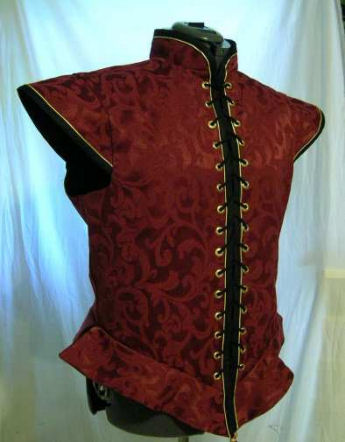
I had to make some adjustments to the incantation to account for the lack of wine, but I managed to cast the divination spell. Unfortunately it wasn’t without some adverse effects to my health, but nothing that wouldn’t fade in time. While the blood pooring from my ears and nose was running down my face, I uncovered the mysteries of the red doublet and the brass knuckles. Especially the doublet was a shocker; magical vestments made of the supplest of dragonskin leather, taken from the belly of very young dragons. Treated and cured to an exceptional suppleness so as not to hinder the wearer in any way.
The Dragonskin Doublet
It seemed the doublet offered its wearer enchanced ability to cast fire-based arcane spells and some resistance to withstand heat, as well as the ability to defend against physical attacks. Apparently there are several such doublets around the world. This one is made of red dragonskin, but there other others, made from other types of dragon leather which offer other benefits. It’s amazing how readily my companions thought the vestments should go to me. I have often seen magical items at school but never have I been an owner of one!
Identify
Mindoraan faal laas do aan geinzun.
Comprehend the life of a thing.
Day 16
The following day, I woke up without injury only to find that Jago and Quentyn were out in the yard of the inn having a fist-fight over who was going to use the Heavy Hands, as I divined they were called. It was decided they should go to the one most able to use them, and so they fought. In the end, it was an interesting test of pugilism, and it was clear yet again that strength doesn’t win out over skill, and Jago was awarded the Heavy Hands.
During breakfast, a local boy named Eirik brought us a message that Creighton wanted to see Quentyn and myself. When we reached the castle, it was clear that Creighton, who had once again taken up residence on the grounds of the castle, was very tired. He had been auditing the wizard’s inventory. The widow had been difficult, Wulfric had been trying to get an advance on the inheritence and in general people had been causing him a headache. He had called us over in order to show us a piece from Lord Marbrand’s notepad, a short sentence reading;
The blood of the heir shall open the box?
Things started to fall into place quickly. It was the key to confirming many of our suspicions and the thing that tied all of this together. We rushed to the library, found Harren’s box and after dropping several drops of Quentyn’s blood into the box, managed to open it and find a letter written by Harren and several items.
To my Descendant,
It is the 5th day of Flamerule in the year of the Tireless Lutes, 1084 as reckoned in the Dalelands. A fortnight ago I and six of my kinsman, and two hirelings ventured onto the Thar the confront an ancient evil. Though we slew the Beast, we have failed to destroy it utterly, and I fear it shall return. If you are reading this, than my fears must have come true.
The Beast you are facing has many names but is most commonly known as Yurtrus’ Plague. It is believed the Thar once was home to a powerful confederation of Orcs, Vorbyx, which subjugated much of the North by force of arms. It is also believed that they fell from pride by a dreadful terror sent by the god Yurtrus; a demon by the name of Nar-Narg-Naroth.
Before the Stag I have vowed that the Beast will be undone by my blood. The plan was straightforward; me and my kinsmen would slay the demon, whilst the hireling mages would ensnare its soul. The soul was to be ensnared inside a flawless, perfectly spherical bloodstone. Alas, Lady Tymora did not favor our endeavor; The stone must have had a blemish, for it failed to trap the soul of the Beast. The stone exploded and took the head of one of the mages clean off.
By the Stag, we have fought hard and true; we brought down Yurtus’ Plague, but did not overcome it utterly. I have lost three of my kinsman today, and both hirelings. I have failed to fulfill my sacred vow to the Stag, our tribe’s protector, and have placed upon my ancestors a heavy burden. For that I can only beg for forgiveness.
I shall bring my kinsman close to the Thar and build a castle, so that my ancestor shall find himself close to the Beast when his fate calls. Take my hammer and the sacred scrolls and imprison the Beast’s soul for ever more.
May the Stag guide your path,
Harren of Clan Martell called Demonsbane
The letter was from Harren and addressed to his descendant, telling him of defeating the demon and sealing it in a bloodstone in the ruins. Harren knew the banishment would not be permanent and that it would be his ancestor’s duty to finished what he started. It was why he moved his kinsmen close to the Thar and founded Glister.
I think it is time I make mention of the fact that I realise that the infernal outsiders are technically devils and not demons. Tanar’ri are demons, but try and make that distinction to some of the people I’ve had to deal with!
The box contained: Harren’s letter, a copy of the custom Imprisonment spell to thrap the soul of the demon (devil!) in a bloodstone, five pearls, a magical ring, bone meal, cockatrice tail-feather, and several other items necessary to perform the Imprisonment abjuration.
I noticed that Quentyn’s new belt, given to him by Harald, once held a buckle adorned with the head of a boar, but now showed the head of a stag, Quentyn’s newfound family totem. Also, while asked by David if he was ready to be thrust into the role of protector of Glister, Quentyn started to talk about what he considered to be his duty, I noticed the candles on the walls seemed to flicker and briefly cast shadows of regal stags upon the wall. I decided I was going to have a word with Harald about the origins of that belt.
It turned out that Harald had created the belt himself, carved the buckle into the image of a boar, cured the leather, all the while performing the ancient rituals of his tribe to curry favour with the boar totem. He wasn’t aware the belt was magical, but seemed glad to know that his rituals had worked.
We ended up inviting Gustav the elder and Lady Ulrikke over to Castle Glister and laid out the entire story to the both of them. Gustav seemed genuinly perplexed by it all, and more than a little worried about the demon (devil!) on the Thar. This was quickly going beyond his ability to comprehend, much like my conversation with Harald about the belt. Lady Ulrikke was hard to read, as always, but seemed open and willing to fight whatever evil lay beneath the barrow.
In the end, this also solidifies Quentyn’s claim on the inheritence, but there is still room for debate. I do believe that if he leads a force to defeat the demon (devil!), he should have a nearly undeniable claim to the inheritence of Lord Marbrand, and hopefully, I can have a claim at the old wizard’s library.